
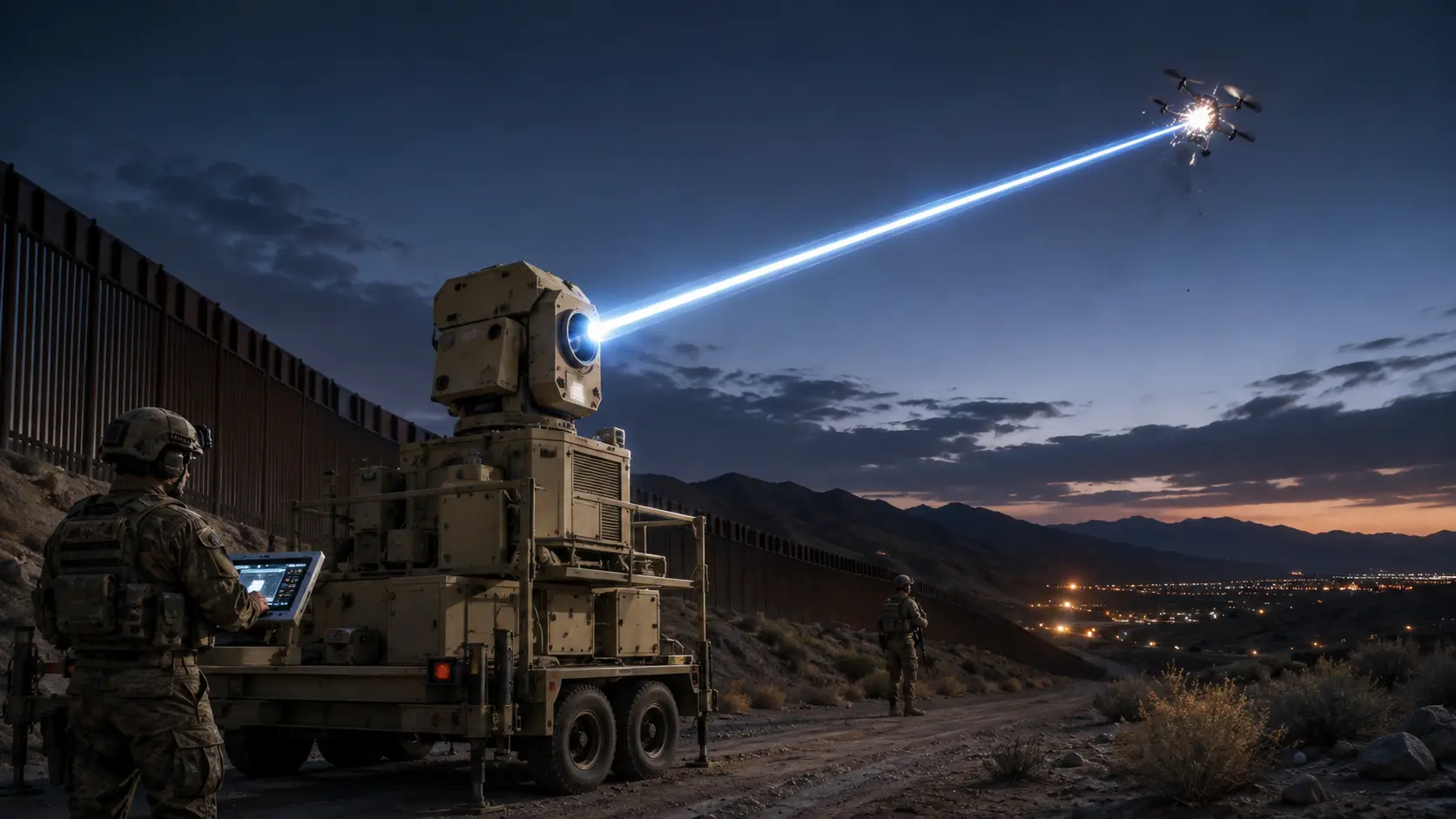
The most important thing about three drones being shot down along the southern border this week may not be that the Army used a laser to do it.
It may be why those drones were there in the first place.
Joint Task Force–Southern Border announced Thursday that U.S. personnel used the Army Multipurpose High Energy Laser system to defeat three hostile unmanned aircraft during operations spanning the late-night hours of August 25 and 26.
U.S. Northern Command said the drones were classified as hostile because they were being used in direct support of activity posing a physical threat to American military personnel and Customs and Border Protection officers.
That makes the incident more than a technology test. A directed-energy weapon was used in an active homeland-security mission against aircraft the military says were supporting cartel-linked operations.
Cartels have developed an air capability of their own
Drones have fundamentally changed what criminal organizations can see and do along the border.
Small unmanned aircraft are cheap, commercially available, difficult to detect at low altitude and capable of flying over terrain that would expose a human scout. Cartel networks can use them to watch Border Patrol movements, identify gaps in coverage, guide smugglers, monitor law-enforcement staging areas and potentially carry contraband or other payloads.
Maj. Gen. Curtis Taylor, commander of Joint Task Force–Southern Border, said cartel networks are increasingly employing unmanned aircraft to facilitate illicit human smuggling and conduct surveillance against U.S. personnel and law-enforcement partners.
The Army had already warned about the scale of the problem. In June, when it announced a $13.8 million counter-drone contract for the southern border, the service said as many as 1,000 cartel drones cross the border each month for missions including drug smuggling and intelligence, surveillance and reconnaissance.
If that estimate is even approximately correct, the border increasingly has an air-security problem in addition to a ground-security problem.
This time, the answer was directed energy
The Army Multipurpose High Energy Laser does not fire a bullet or missile at an incoming drone. It concentrates energy on the target until critical components are damaged and the aircraft can no longer continue its mission.
That gives directed-energy systems potentially important advantages against inexpensive drones.
Traditional air-defense interceptors can cost vastly more than the small aircraft they destroy. The Government Accountability Office has noted that directed-energy weapons can be less expensive per shot and, as long as the system has sufficient power, can offer an effectively deep magazine without stocks of conventional interceptors.
That cost equation matters when an adversary can buy or assemble drones cheaply and send them repeatedly.
Using an expensive missile against a commercial-style quadcopter may work tactically but become a losing exchange over time if a cheaper system can reliably defeat the same threat.
Lasers offer another layer.
But this is not a miracle weapon
The successful engagements should not turn into another Pentagon story in which a promising technology is treated as if it solved an entire mission by itself.
High-energy lasers still have meaningful limitations.
They require line of sight. Atmospheric conditions such as fog, dust, smoke and storms can reduce effectiveness. The system must track the target precisely and maintain energy on a vulnerable point long enough to produce damage. Power generation and cooling remain engineering constraints.
That is why military planners describe counter-drone defense as layered.
Electronic warfare may disrupt one aircraft. Guns or missiles may defeat another. High-powered microwaves could become useful against groups of drones. Lasers may be ideal under other conditions.
No single system solves the entire problem.
The border is becoming an operational test bed
The Army’s deployment matters partly because it gives operators a place to learn which systems work outside a controlled test range.
The southern-border task force has increasingly used sensors, unmanned aircraft, counter-drone systems and other emerging technologies in support of Customs and Border Protection. The latest engagements show directed energy moving from field testing to real-world defensive use in that mission.
Approximately 8,000 service members are currently deployed under Joint Task Force–Southern Border across the nearly 2,000-mile frontier, according to the military. Their work includes surveillance, patrol support, aviation, engineering, barriers and technology supporting CBP.
The drone threat shows why that mission is becoming increasingly technical.
There are still important unanswered questions
Northern Command has not disclosed exactly where the drones were engaged or which criminal organization allegedly controlled them.
CBS News reported that when asked whether the aircraft were over U.S. or Mexican airspace, a NORTHCOM spokesperson declined to specify the location, citing operational security, while saying the engagements were coordinated with partners operating along the border.
That information matters.
The United States plainly has authority to defend American forces against hostile aircraft operating in U.S. territory. Operations involving Mexican airspace raise additional sovereignty, coordination and rules-of-engagement questions.
The military says Mexican Army partners are working alongside the task force against cartel drone activity, which is encouraging. Operational success should still be accompanied by clarity about where American weapons are being employed and under what authority when disclosure would not compromise current missions.
The laser is the headline. The cartel capability is the story.
It is easy to focus on the futuristic part of this week’s announcement: an Army laser destroyed three drones.
That is significant.
But the larger development is that organized criminal networks operating across America’s southern border have apparently developed an aerial surveillance and support capability serious enough that the United States is deploying military counter-drone systems to defeat it.
A border-security strategy designed only around fences, patrol vehicles and agents on the ground is defending yesterday’s battlefield.
Criminal organizations can now observe law enforcement from above in real time. Future threats could involve larger aircraft, autonomous navigation, encrypted communications, swarms or drones carrying dangerous payloads.
The military does not need to exaggerate that possibility. It needs to prepare for it.
The southern border is no longer only a line on the ground. It is increasingly contested airspace too.