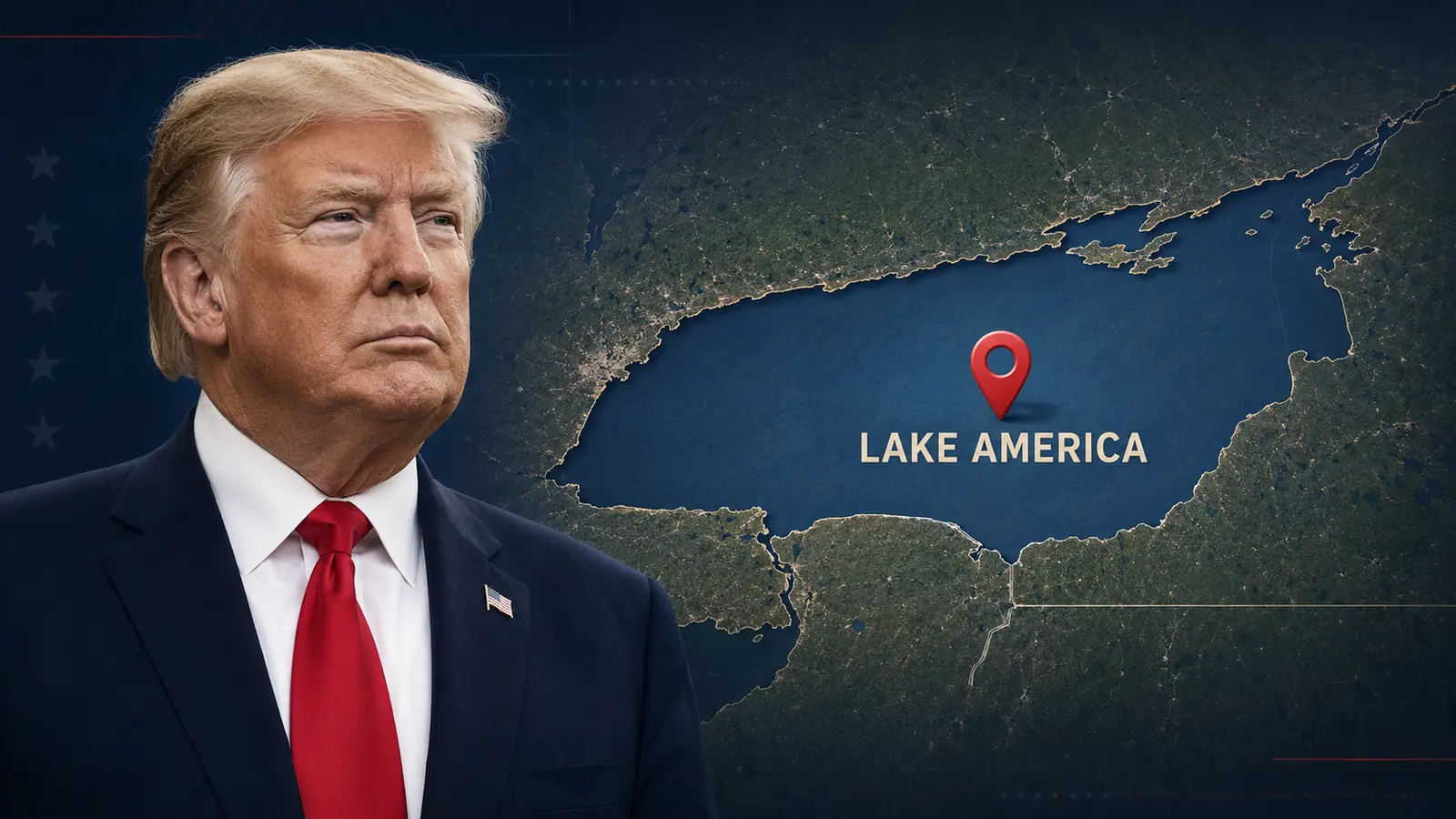
President Donald Trump’s decision to rename Lake Ontario “Lake America” for federal use was designed to send a message: the United States is finished treating American power, protection and market access as benefits other countries may take for granted.
Canada’s leaders predictably called the move provocative. Prime Minister Mark Carney said his country would continue calling the lake by its historic name, and New York Governor Kathy Hochul also rejected Trump’s label. Their objections do not change what the executive order actually controls. Within the federal government, the name is changing.
The larger question is whether the policy behind the symbolism will deliver.
Trump has a legitimate case against Canadian trade barriers. American producers should not face restricted access to Canadian markets while Canadian companies enjoy broad access to ours. Friendship does not require economic surrender, and “free trade” that tolerates selective discrimination is not truly free.
But a successful America First policy must produce more than a memorable map. The tariffs now hitting Canadian goods should be judged by the concessions they secure, the American capacity they rebuild and the costs they impose on U.S. families and manufacturers along the way.
What the Lake America order changes
Trump’s August 27 executive order directs the secretary of the interior, working with the U.S. Board on Geographic Names, to rename Lake Ontario “Lake America” in the federal Geographic Names Information System within 30 days. Federal departments and agencies will then use the new designation on maps, contracts, documents and official communications.
That is a real exercise of federal naming authority. It is also limited to the jurisdiction of the United States government.
The order does not move the international boundary, transfer Canadian waters to American control or force Canada, private mapmakers or international organizations to adopt the name. The lake remains shared between New York and the Canadian province of Ontario. Washington can determine how its own agencies refer to it; it cannot dictate Ottawa’s vocabulary.
None of that makes the order meaningless. Presidents routinely use names, ceremonies and executive symbolism to declare national priorities. Trump’s message is that an economically and strategically important resource should be described in language that recognizes America’s role in its development, protection and commerce.
Conservatives do not need to pretend the order accomplishes more than it does in order to understand why it resonates. It is a declaration of national confidence. The administration’s challenge is to convert that confidence into measurable economic leverage.
Trump is right about the central trade grievance
For decades, Washington’s bipartisan trade establishment treated rising trade volume as proof that an agreement was working. Factory closures, lost bargaining power and dependence on foreign supply chains were dismissed as temporary dislocations while economists pointed to lower aggregate prices.
That approach failed too many American communities.
Canada is not the worst offender in the global trading system, but its status as an ally does not place its policies beyond scrutiny. Ottawa protects politically powerful sectors, particularly dairy, through supply management and tariff-rate quotas. The United States has repeatedly challenged Canada’s administration of dairy access under the USMCA. Washington won a meaningful panel ruling over Canada’s reservation of quota access for domestic processors, even though a later panel rejected the main U.S. challenge to Canada’s revised system.
The administration also points to restrictions on American alcohol. According to the White House, all but two Canadian provinces and territories stopped purchasing, distributing or selling U.S. alcoholic beverages, contributing to an 81 percent decline in Canadian imports of American alcohol between March 2025 and February 2026 compared with the previous year.
On vehicles, the administration says Canadian quotas and their implementation favor foreign competitors and pressure U.S. companies to move production north of the border. The White House reports that Canadian imports of American motor vehicles fell by approximately 22 percent—or $5.6 billion—from April 2025 through March 2026 compared with the previous 12 months.
Those are the administration’s findings, and the details will be contested. But the principle should not be: access to the American market is valuable, and Washington is entitled to demand reciprocal treatment for American workers, farmers and businesses.
How the tariff fight escalated
The current confrontation began before Trump signed the renaming order.
On July 1, the United States declined to renew the USMCA for another 16-year term in its current form. That did not terminate the agreement. The USMCA remains in force, but the three countries now face annual reviews unless they agree to an extension before its scheduled 2036 expiration.
On July 20, Trump invoked Section 338 of the Tariff Act of 1930 to impose additional 50 percent tariffs on nearly $20 billion in Canadian imports. The three actions targeted disputes involving motor vehicles, alcoholic beverages and dairy. The duties took effect August 22 after negotiations collapsed.
The covered products do not receive the USMCA’s normal preferential treatment. That gives the tariffs real force—and gives both governments a reason to negotiate. Washington says Canada walked away from terms that would have placed it in a better tariff position than other major exporters. Carney says the United States changed the proposed terms at the last minute. No additional talks were scheduled when the duties took effect.
Canada responded with planned countertariffs of 15, 25 and 50 percent on approximately C$27.6 billion, or about US$20 billion, in American goods beginning September 8. The list covers hundreds of products, including steel, aluminum, machinery, electronics, prepared foods, clothing and furniture. Ottawa also announced a C$7.5 billion support package for affected businesses and workers.
This is no longer a war of words. Governments on both sides are using taxes, subsidies and market access to create political pressure.
Canada’s seafood retreat proves leverage can work
One of the most revealing developments came less than a day after Canada announced its retaliation.
Ottawa removed American fish and seafood from the countertariff list after receiving industry feedback. Canada’s Department of Finance said it made selected adjustments to protect against economic harm.
That retreat undercuts the claim that tariffs are costless displays of national strength. Canadian officials discovered what American policymakers must remember as well: a tariff aimed at a foreign producer can also punish domestic importers, restaurants, retailers and families.
It also demonstrates the value of pressure. Governments revise policy when the political and economic costs become concrete. The Trump administration is correct to use American market power as leverage rather than accepting endless consultations that never remove the underlying barrier.
The goal, however, should be a concession—not the permanent existence of the tariff itself. Leverage succeeds when it changes the other government’s behavior.
Tariffs are a tool, not a magic trick
Tariffs can protect strategic industries, answer discriminatory treatment and bring a reluctant trading partner back to the table. They can also raise costs for American companies that rely on imported parts or materials.
The importer legally pays the duty when a product enters the United States. The final economic burden can be shared among the foreign producer, the importer, the retailer and the customer depending on competition, contracts, currency movements and the availability of substitutes.
Federal Reserve research on the 2025 tariffs found that they raised retail prices, though the effect appeared more gradually and less sharply than during the 2018–2019 China tariff round. That evidence does not prove tariffs are always mistaken. It proves that serious policymakers should identify which industries justify the cost and how long the measure is expected to remain.
The scale of the U.S.–Canada relationship makes discipline especially important. U.S. goods and services trade with Canada totaled an estimated $872.3 billion in 2025. The United States ran a $48.3 billion goods deficit but a $27.7 billion services surplus. Cross-border production connects energy, autos, machinery, agriculture and defense supply chains.
That integration can make America vulnerable when Canadian policy discriminates against U.S. producers. It can also mean that a tariff on a Canadian input raises costs for an American factory. An America First government should distinguish between the two rather than treating every import as equally dangerous.
The conservative scorecard for success
Trump deserves credit for rejecting the passive assumption that allies are automatically entitled to one-sided access to the American economy. The administration has named concrete disputes involving dairy, alcohol and vehicles. It has imposed consequences and forced Canada to calculate the cost of continued resistance.
Now it should publish a clear scorecard.
Which Canadian barriers must be removed? What level of market access will count as success? Which duties will be lifted when Canada complies? Which industries require lasting protection for national-security reasons? How will Washington prevent higher input costs from weakening the American manufacturers the policy is meant to strengthen?
Those questions are not an argument for retreat. They are the difference between strategic leverage and an open-ended trade war.
If the tariffs secure enforceable access for American farmers, distillers and manufacturers, strengthen domestic production and reduce dependence on hostile powers, Trump will have vindicated the strategy. If the result is only retaliatory taxes, federal relief programs and permanent uncertainty, then government will have created activity without achieving victory.
Conservative economic policy should be nationalist in purpose and disciplined in execution. It should defend American workers without pretending markets no longer exist. It should protect critical capacity without allowing every politically connected industry to declare itself strategic. And it should use tariffs to obtain results, not as a substitute for defining them.
Canada is an ally—but allies still need boundaries
Canada is not China. It is a treaty ally, a major purchaser of American goods, an energy and defense partner and part of a continental industrial base that can reduce dependence on hostile regimes.
That distinction matters strategically. The United States should not weaken North American production so severely that China becomes the beneficiary of a dispute between allies.
But alliance is not submission. Canada should not expect special access to the world’s largest market while sheltering favored industries, restricting American goods or using retaliatory measures to pressure U.S. voters. Close partners owe each other reciprocity precisely because the relationship is valuable.
Trump’s instinct—to stop apologizing for American leverage—is correct. The responsibility now is to wield that leverage with enough precision to leave American industry stronger when the confrontation ends.
The bottom line
“Lake America” is a federal name and a political message. It does not enlarge the United States, shrink Canada or resolve a single trade dispute by itself.
The tariffs are different. They can alter prices, contracts, supply chains, investment and jobs. They can force concessions, or they can become a costly stalemate.
The administration’s strongest argument is that American market access should command fair treatment in return. That is an America First principle worth defending. The proof will not be the words printed on a federal map. It will be the barriers removed, the factories strengthened, the exports restored and the deal President Trump ultimately brings home.
Supporting Trump means giving him credit for confronting a real problem. Principled conservative coverage also means judging the outcome by results rather than applause. The President has put Canada on notice. Now the policy must deliver for the American people.
Sources
- White House executive order renaming Lake Ontario for U.S. federal use, August 27, 2026.
- USTR statement on President Trump’s Section 338 tariffs against Canada, July 20, 2026.
- White House fact sheet on Section 338 tariffs against Canada, July 20, 2026.
- USTR statement on the 2026 USMCA joint review, July 1, 2026.
- USTR Canada trade summary, with 2025 goods and services figures.
- USTR account of the first Canadian dairy-quota panel, January 4, 2022.
- USTR account of the second Canadian dairy-quota panel, November 24, 2023.
- Government of Canada countertariff and business-support announcement, August 25, 2026.
- Government of Canada countertariff product list, updated August 26, 2026.
- U.S. Customs and Border Protection guidance on importer responsibility for duties.
- Federal Reserve analysis of tariff effects on 2025 retail prices, March 5, 2026.
- Federal Reserve comparison of tariff pass-through periods, April 8, 2026.
- U.S. EPA overview of Lake Ontario as a shared U.S.–Canada lake.
- U.S. Geological Survey explanation of the Board on Geographic Names’ federal role.
- NORAD description of the U.S.–Canada binational defense command.
- Reuters on the collapse of the trade talks and the new U.S. tariffs, August 21–22, 2026.
- Reuters on Canada’s removal of seafood from its retaliation list, August 27, 2026.
- Reuters on the scope of the Lake America order and Canada’s response, August 27, 2026.