Six months ago, President Donald Trump made the most consequential decision of his second term: he ordered American forces into a coordinated air campaign with Israel against Iran.
The opening strikes were devastating. Iran’s supreme leader, Ayatollah Ali Khamenei, was killed along with senior political and military officials. Command centers, missile sites, air defenses, naval assets and defense-production facilities came under sustained attack. American air and naval power demonstrated once again that no conventional military in the region can match it.
But wars are not graded only by the targets destroyed in their opening hours.
They are judged by what follows: whether the threat that justified the war has actually been removed, whether the enemy can still harm Americans and their allies, whether the economic cost is sustainable and whether the country has moved closer to a stable peace.
By that standard, the Iran war has reached an uncomfortable six-month mark. The United States has won important battles. It has not yet secured the political outcome that would allow the country to say the war is finished.
That is not an argument for surrender, and it is not a denial of what American service members have accomplished. It is the basic distinction between military success and strategic success. A patriotic country should be able to recognize both.
Why the war began
The conflict did not emerge from a single incident.
For decades, the Iranian regime financed armed groups across the Middle East, developed increasingly capable missiles and drones, threatened Israel, targeted American interests and moved steadily closer to the ability to produce weapons-grade nuclear material. Trump returned to office promising that Iran would never obtain a nuclear weapon and that its missile, naval and proxy networks would no longer be allowed to terrorize the region without consequence.
Diplomacy continued into the final days before the attack. U.S. and Iranian negotiators met in Geneva on February 26, with Oman mediating. Oman said progress had been made, but the talks ended without the breakthrough Washington demanded. The central dispute remained Iran’s insistence on retaining an enrichment capability while the United States sought much deeper restrictions and reliable verification.
On February 28, the United States and Israel launched the war.
The Trump administration publicly defined a broad mission: destroy Iran’s ballistic-missile and drone capacity, cripple its navy and defense industry, cut its support for terrorist proxies and ensure it could never acquire a nuclear weapon. Trump also encouraged the Iranian people to reject the ruling system, adding regime change to the political atmosphere even when administration officials did not always describe it as a formal military objective.
Those were ambitious goals. Some have been advanced. None can honestly be declared permanently completed.
Six months of war
February 28 to early March: shock, decapitation and retaliation
The opening U.S.-Israeli strikes killed Khamenei and other senior officials and hit Iranian command-and-control systems, naval forces, missile and drone sites, air defenses and intelligence infrastructure. The goal was to disorient the regime, suppress its ability to respond and establish freedom of action in Iranian airspace.
Iran responded almost immediately. It launched missiles and drones at Israel and at American and allied facilities across the Gulf. It also moved to restrict traffic through the Strait of Hormuz, the narrow waterway through which roughly one-fifth of the world’s traded oil and liquefied natural gas had moved before the war.
That response changed the nature of the conflict. What began as a campaign against Iran’s military and nuclear threat became a regional war touching Israel, Lebanon, Gulf states, U.S. bases and commercial shipping.
March: the campaign expands and the timeline slips
Throughout March, the United States and Israel expanded their target lists. Iran’s missile infrastructure, naval capability, defense production, security apparatus and other military assets were struck repeatedly. Hezbollah entered the war from Lebanon, drawing a major Israeli response and widening the battlefield.
Trump initially suggested the operation could be measured in weeks. As Iran continued firing and commercial traffic through Hormuz collapsed, the administration’s language changed from a short, decisive campaign to doing “whatever it takes.”
The shift did not mean the opening strategy had failed. It meant Iran had found an asymmetric answer to American conventional superiority. Tehran could not defeat the U.S. military in a direct fight, but it could threaten tankers, Gulf infrastructure and allied territory, raising the cost of continuing the war.
April: the first ceasefire and the blockade
An early-April ceasefire reduced the intensity of U.S.-Iran fighting, but it did not settle the disputes underneath it. Talks in Pakistan failed to produce a final agreement. The United States then imposed a blockade on Iranian ports in an effort to pressure Tehran into releasing its grip on Hormuz and accepting broader American terms.
This was the point at which the war increasingly became an economic contest. Washington sought to deprive the regime of oil revenue and access to international commerce. Iran used the strait as leverage over the global economy.
Neither side was willing to give up its strongest pressure point first.
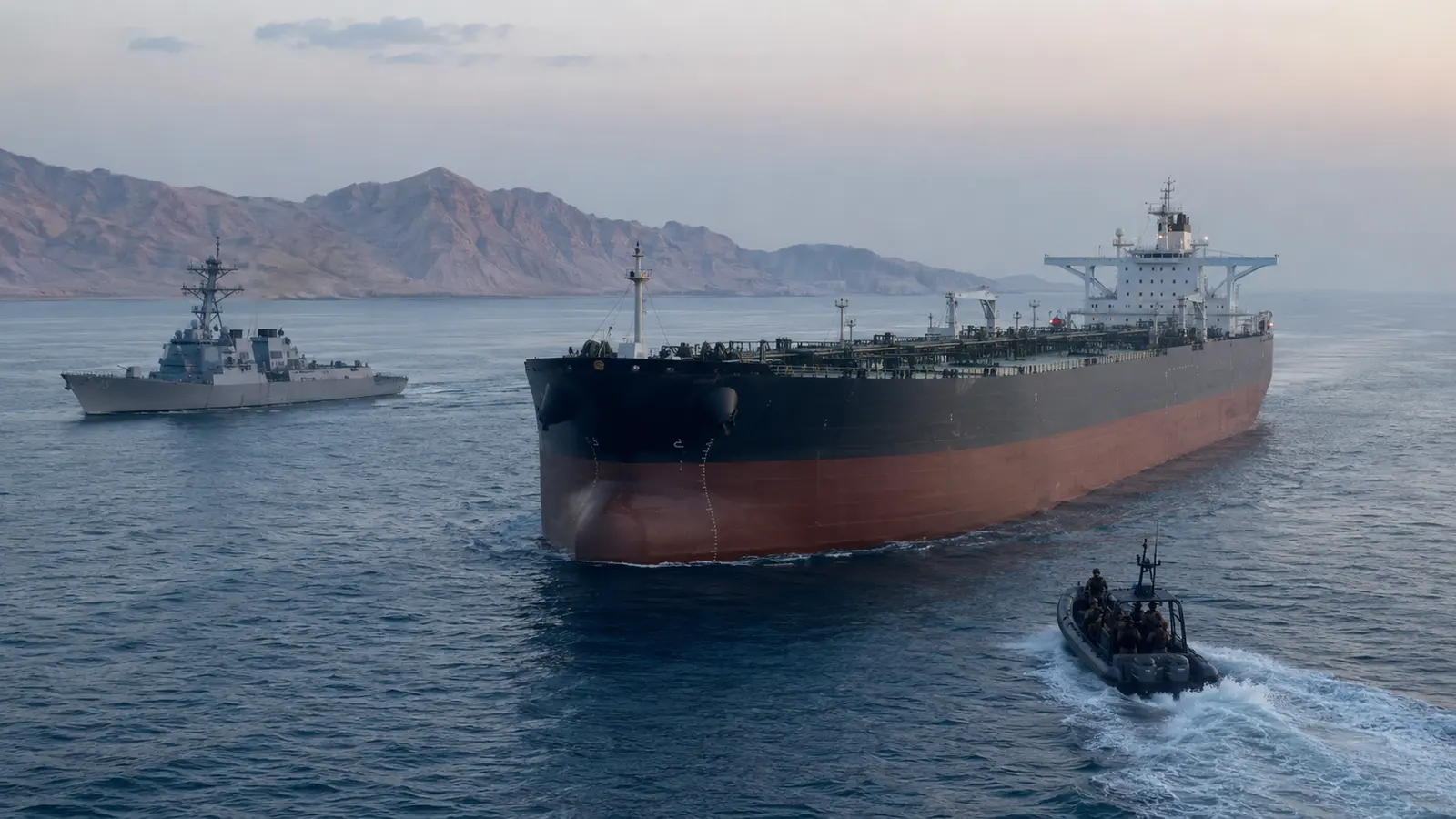
The blockade also became a campaign of physical interdiction, not merely radio warnings and sanctions notices. On April 19, U.S. forces seized the M/V Touska, an Iranian-flagged container ship—not a tanker—after CENTCOM said it ignored repeated warnings while attempting to enter an Iranian port. The destroyer USS Spruance disabled the ship's propulsion, and Marines from the 31st Marine Expeditionary Unit boarded it by helicopter and took custody of the vessel.
The next operations reached much farther from Iran. U.S. forces and law-enforcement personnel boarded the M/T Tifani in the Bay of Bengal on April 20-21. Gen. Dan Caine said the tanker carried about 2 million barrels of sanctioned Iranian oil; a Navy control team assumed control after troops fast-roped onto the deck. On April 22, U.S. forces boarded and secured the M/T Majestic X, another very large crude carrier, in the Indian Ocean. The Pentagon said both tankers and their crews remained in U.S. custody after the operations.
On May 19, the Wall Street Journal, citing three U.S. officials, reported that American forces had seized a third Iran-linked tanker, the Skywave, in the Indian Ocean. Reuters reported the account but said it could not independently verify the seizure at the time. The Skywave had been sanctioned in March for transporting Iranian oil and was believed to be carrying more than 1 million barrels loaded at Kharg Island.
Those distinctions matter. The Touska was a container ship captured while allegedly breaching the announced blockade. The Tifani and Majestic X were oil tankers interdicted far from Iranian waters as part of sanctions and maritime-enforcement operations, while the Skywave seizure entered the public record through reporting attributed to U.S. officials. Together, the cases show how the conflict expanded from strikes over Iran into a worldwide effort to cut off the regime's oil revenue—and why the legal and diplomatic stakes extend well beyond the Strait of Hormuz.
May: ceasefire on paper, danger at sea
May brought repeated flare-ups around the Gulf. Missiles, drones, small boats and attacks on commercial shipping tested the ceasefire. The United States escorted vessels and struck Iranian assets after threats and attacks. Iran continued to claim authority over the strait while Washington insisted it was an international waterway.
Negotiators discussed extending the truce and reopening Hormuz, but the same sequencing problem kept returning: Iran wanted the American blockade lifted; the United States wanted unrestricted navigation and enforceable Iranian concessions before giving up its leverage.
June: an interim deal that postponed the hardest questions
On June 17, Washington and Tehran signed a 14-point memorandum of understanding extending the ceasefire for 60 days and establishing a framework for broader talks. It called for an end to military operations, free commercial passage through Hormuz, sanctions relief and negotiations over Iran’s nuclear stockpile under International Atomic Energy Agency supervision.
The agreement created breathing room, but it deferred the most difficult questions. It did not immediately dismantle Iran’s nuclear program, permanently eliminate its enriched-uranium stockpile, settle control of Hormuz or guarantee an end to Iranian support for armed groups.
The deal was a path toward a settlement, not the settlement itself.
July: the framework breaks down
By July, renewed attacks on tankers and American facilities triggered another round of U.S. strikes. The United States reimposed its naval blockade, and Iran again asserted that the strait was closed or subject to its control. Heavy missile and drone exchanges returned, while mediators proposed another short pause.
The pattern was now established: temporary calm, incompatible interpretations, a new incident and renewed military action.
August: pressure replaces peace talks
The 60-day negotiating window expired without a permanent agreement. Trump said the United States was no longer talking directly with Iran and placed greater emphasis on what his administration calls “Operation Economic Outcast”—sanctions, a blockade and the threat of secondary penalties against countries that continue doing business with Tehran.
At the same time, Qatar and Oman continued working to prevent a wider escalation. Iran and Oman have agreed on the outline and route of a proposed shipping corridor and are finalizing the operating and revenue arrangements. Iran says reopening the waterway will still depend on broader U.S. concessions, including an end to the blockade and sanctions relief. The latest reporting therefore points to a developing framework, not yet a fully implemented settlement.
The distinction is more than diplomatic wording. A signed Iran–Oman statement will matter only if ships can actually move safely, insurers return, Iran stops threatening vessels and the United States accepts the security and enforcement terms.
What America has achieved
The case for the campaign begins with military reality.
Iran’s leadership and command structure suffered losses that would have crippled many governments. Its navy, missile forces, drone infrastructure, air defenses and defense-industrial base were substantially degraded. American and allied forces gained extensive freedom of action, intercepted Iranian attacks and repeatedly demonstrated the ability to hit targets across Iran.
U.S. forces have also cleared mines from international shipping lanes and helped roughly 1,500 vessels transit the strait during the conflict. They boarded and seized the Tifani and Majestic X, seized the Touska after disabling it and, according to U.S. officials cited by the Wall Street Journal, later captured the Skywave. Those operations were difficult, dangerous and strategically important. The sailors, airmen, Marines and soldiers who carried them out deserve credit unburdened by Washington’s political arguments.
Iran is economically weaker, militarily damaged and under greater pressure than it was on February 27. Any honest assessment should acknowledge that.
The regime has also learned that attacking Americans, building a regional missile threat and using proxy forces can bring devastating consequences to its own territory. Deterrence is not measured only by whether an enemy disappears. It is also measured by the price the enemy now understands it will pay.
What remains unresolved
The first unresolved issue is the one that mattered most at the start: Iran’s nuclear program.
Strikes may have delayed parts of the program, but delay is not the same as verified destruction. The IAEA halted nearly all in-field verification in Iran when the war began. It later conducted a routine inspection at the Bushehr nuclear plant, but inspectors have not been able to provide a complete accounting of the other facilities or Iran’s highly enriched uranium.
That leaves the public with competing claims instead of proof. The administration can point to facilities damaged and equipment destroyed. Iran can conceal, relocate or rebuild. Until inspectors regain meaningful access and account for the stockpile, no responsible official can guarantee that the nuclear problem has been solved.
Second, the Iranian regime survived. It is wounded, more isolated and under economic strain, but it remains in control and has shown itself willing to repress domestic opposition. Killing leaders does not automatically change the system beneath them. In some cases, it hardens it.
Third, Hormuz remains far from normal. Despite mine-clearing and escorted transits, current commercial traffic is estimated at only 5 to 15 percent of prewar levels. The economic pressure reaches beyond Iran. Energy prices, insurance costs, shipping schedules and allied economies all absorb part of the damage.
Fourth, Iran can still strike. Its conventional capabilities are weaker, but missiles, drones, fast boats, mines and aligned militias do not have to defeat the United States to kill people, damage infrastructure or trigger another escalation.
Finally, an open-ended campaign consumes munitions, money, readiness and attention. America faces threats in Europe and the Indo-Pacific as well as the Middle East. Strength means being willing to fight when necessary. Strategy means refusing to let one war quietly consume the resources needed to deter the next one.
Where the war stands now
The United States holds the stronger military position. Iran still holds dangerous leverage.
Washington can strike Iran, intercept many of its attacks, enforce a blockade and intensify sanctions. Tehran can impose costs through Hormuz, threaten Gulf infrastructure, use surviving missiles and drones and wait for American public support to weaken.
That is why the current situation is best described as an armed economic stalemate. The United States is trying to make continued resistance more painful than negotiation. Iran is trying to make enforcement more expensive than compromise.
The emerging Iran–Oman arrangement could become the first practical way out. A monitored navigation corridor would allow commercial traffic to recover without requiring either side to settle every dispute on day one. But the proposal could also fail if it grants Tehran an effective veto over international shipping, creates a toll or revenue system that rewards coercion, or cannot operate alongside the American blockade.
For Trump, the test is not whether a deal can be announced. It is whether the deal can be enforced.
What is likely to happen next
The most likely near-term outcome is not total victory or total peace. It is continued pressure interrupted by limited deals and periodic violence.
Four paths now stand out.
A narrow Hormuz agreement. Iran and Oman may complete a shipping arrangement, followed by a limited American adjustment to the blockade. This is the most immediate diplomatic opportunity. If it produces genuinely free navigation with no Iranian veto over lawful commerce, it could lower energy pressure and create room for nuclear talks. If it merely formalizes Iranian control of the chokepoint, Washington will have traded a short-term reduction in oil prices for a long-term strategic concession.
An extended economic war. If maritime talks fail, Trump is likely to rely on the blockade, tougher sanctions and threats against countries buying Iranian oil. This can deepen Tehran’s financial pain, but its effectiveness depends on enforcement against major trading partners such as China and India. Threats that are repeatedly announced but selectively applied will teach Iran where the limits are.
A dangerous new escalation. Another successful strike on a U.S. base, a mass-casualty attack on a tanker or major damage to Gulf energy infrastructure could restart large-scale bombing. Wars with many actors and crowded waterways do not require either leader to choose escalation deliberately. One misidentified drone or miscalculated retaliation can do it for them.
A broader negotiated settlement. This remains the best outcome and the hardest to reach. Any durable agreement would need verifiable nuclear limits, IAEA access, an accounted-for enriched-uranium stockpile, free navigation through Hormuz, an end to attacks on Americans and allies and a phased system for lifting sanctions or the blockade only after compliance. Promises without inspections would not be peace. They would be an intermission.
Internal unrest in Iran may grow as inflation, unemployment and shortages deepen. But American policy should not assume the regime will collapse on a convenient timetable. The Iranian people will determine their country’s political future. Washington’s responsibility is to protect American interests and avoid building its exit strategy around an uprising it cannot schedule or control.
The standard Trump should set
Trump was right about the underlying danger: Iran’s rulers could not be allowed to pair a near-nuclear capability with long-range missiles, terror networks and threats to international shipping.
He was also right to trust the ability of the American military. The opening campaign displayed extraordinary reach, precision and courage.
But support for the troops does not require pretending that every political objective has been met. Six months later, Iran’s military is damaged but active, its government is battered but alive, the status of its nuclear stockpile remains uncertain and the world’s most important energy chokepoint is still operating at a fraction of normal traffic.
The administration should now state the end condition in language the public can measure: verified nuclear limits, restored inspections, safe and toll-free commercial passage through Hormuz, an end to attacks on U.S. personnel and allies, and a phased, reversible process for lifting pressure only when Iran complies.
If the Iran–Oman framework helps reach those goals, Trump should use it. If it rewards Tehran with control over an international waterway, he should reject it. If sanctions are the strategy, they must be enforced consistently. And if American forces are expected to remain in an open-ended war, Congress and the public deserve a direct debate about the mission, cost and legal authority.
Conservatism is not isolationism, and it is not permanent war. It is the disciplined use of American power for defined American interests.
The United States has shown Iran what its military can destroy. The next challenge is proving what that destruction achieved—and turning six months of sacrifice into a peace that can actually be verified.
Sources
- White House: Operation Epic Fury objectives
- U.S. Central Command: Operation Epic Fury
- Reuters: U.S.-Iran nuclear talks end without a prewar breakthrough
- Associated Press: Timeline of the Iran conflict and ceasefire efforts
- U.S. Department of War: Joint force enforcement of the Iran blockade
- U.S. Department of War: Gen. Dan Caine details the Tifani and Majestic X interdictions
- U.S. Central Command: U.S. forces take custody of the M/V Touska
- Associated Press: U.S. forces board and capture the M/T Tifani
- Associated Press: U.S. forces seize the M/T Majestic X
- Reuters: Reported U.S. seizure of the Skywave
- Reuters: Has Trump achieved his stated goals in Iran?
- Reuters: The 14-point U.S.-Iran interim agreement
- IAEA: June 2026 statement on verification activities in Iran
- Reuters: Six consequences after six months of war
- Reuters: Six-month conflict reaches a costly stalemate
- Reuters: U.S. shifts emphasis toward economic pressure
- Reuters: Iran and Oman work toward a Strait of Hormuz arrangement
- Reuters: Iran sets conditions for reopening the strait
- Associated Press: Iran and Oman discuss a phased shipping framework