
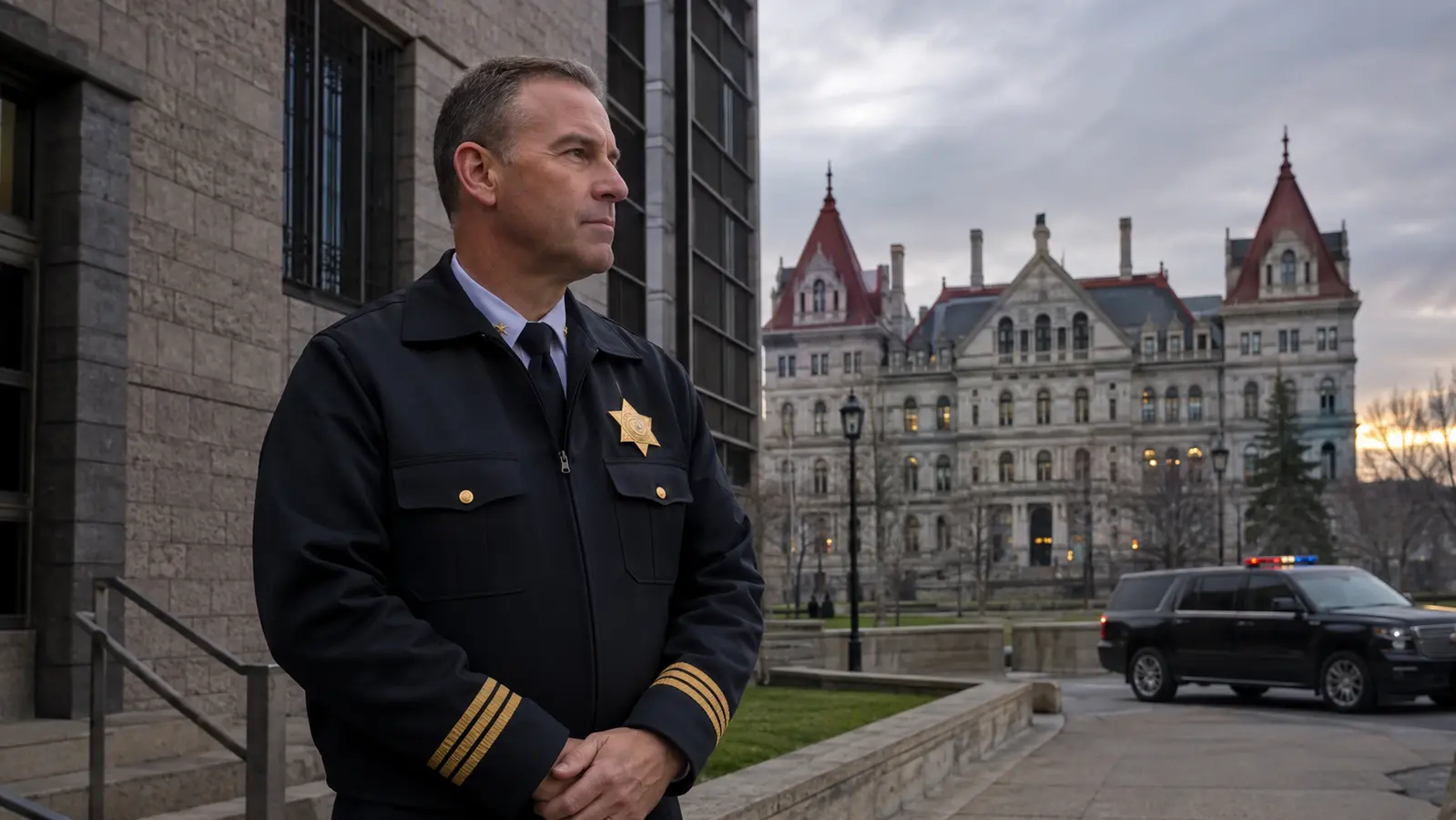
Governor Kathy Hochul calls it the “Local Cops, Local Crimes Act.” Fifteen New York sheriffs see something very different: Albany politicians ordering independently elected law-enforcement officials to end cooperation with federal immigration authorities, surrender existing contracts and accept oversight from a newly created state enforcement office.
The sheriffs filed a federal lawsuit on August 25—the same day the central provision of Hochul’s law took effect. Led by Rensselaer County Sheriff Kyle Bourgault, they are asking a judge to declare the law unconstitutional and block Hochul, Attorney General Letitia James and the state from enforcing it against them.
Two days later, James and Hochul answered with a state lawsuit against Bourgault and Rensselaer County, the only jurisdiction that had not indicated it would terminate its formal agreement with U.S. Immigration and Customs Enforcement.
This is now more than another argument about Donald Trump, ICE or sanctuary policies. It is a direct contest over who controls local law enforcement in New York: the sheriffs elected by county voters or the state government in Albany.
The sheriffs make a serious public-policy case. Their constitutional case is more complicated.
What Hochul’s law actually does
The dispute centers on Section 287(g) of the federal Immigration and Nationality Act. That program allows ICE to enter written agreements with state or local agencies and train designated local officers to perform certain federal immigration functions under federal supervision.
The New York law prohibits state and local law-enforcement agencies from entering into, renewing or remaining in those agreements. Existing 287(g) partnerships had to be terminated by August 25. The statute also requires local agencies to unwind agreements that house people detained for federal civil immigration violations, although those contracts have a later deadline.
Hochul argues that locally funded police and jail personnel should focus on local crime rather than act as what she calls “de-facto ICE agents.” Her administration says immigrant residents are less likely to report crimes, cooperate as witnesses or seek help when they believe local officers may place them into the immigration system.
That is the best argument for the law, and it should not be dismissed. Police need cooperation from crime victims and witnesses, including people who are not lawfully present. A domestic-violence victim should not be afraid to call 911, and a witness should not believe that helping detectives will automatically bring ICE to the door.
But that argument does not answer what many of these sheriffs say their agreements actually do.
The plaintiffs describe programs centered on county jails, where trained personnel identify and process removable noncitizens who are already in custody on state or local criminal matters. They say the partnerships allow an orderly transfer to federal custody and are not roving immigration sweeps through neighborhoods.
That distinction matters. Albany repeatedly presents the issue as local police abandoning crime victims to carry out mass deportations. The sheriffs present it as jail officials communicating with ICE before releasing someone already arrested or jailed for an unrelated offense.
The public deserves to know which description matches each county’s actual program.
What the sheriffs are arguing
The 60-page complaint advances seven claims under the federal and New York constitutions.
First, the sheriffs argue that New York is impairing existing contracts. Their 287(g) agreements and federal detention arrangements involve training, credentials, bed space, supervision and reimbursement. The state law does not merely regulate future agreements; it declares existing ones inconsistent with state law and forces their termination.
Second, they claim New York is engaging in what the complaint calls “reverse commandeering”—using state power to force local officers to obstruct a cooperative federal program. That is an aggressive and relatively novel extension of the constitutional rule that normally prevents the federal government from ordering states to administer federal programs.
Third, the lawsuit argues that the state law is preempted by federal immigration law because Congress deliberately authorized cooperation between ICE and local agencies.
The remaining claims rely on New York’s constitution. The sheriffs say they are independently elected constitutional officers, not subordinates of Hochul or James. They argue that managing county jails, allocating local resources and entering law-enforcement agreements are protected by the independence of the sheriff’s office, home-rule guarantees and separation-of-powers principles.
They also challenge the state’s new Office of Immigrant Trust, which can issue subpoenas, inspect facilities and bring civil enforcement actions. To the sheriffs, that office is an Albany-controlled mechanism designed to coerce separately elected local officials.
The lawsuit asks for temporary and permanent injunctions preventing the state from enforcing the challenged provisions against the sheriffs.
Where the sheriffs’ case is strongest
Their strongest argument may be that Hochul’s law is far broader than necessary to prevent local officers from conducting civil immigration sweeps.
New York could have prohibited street-level immigration task forces while allowing limited jail-based cooperation involving people already in criminal custody. It could have required county legislative approval, public reporting, federal training and clear restrictions on which inmates may be processed. It could have required judicial warrants before prolonged detention.
Instead, the state imposed a categorical ban and created a dedicated enforcement office to police compliance.
That supports the sheriffs’ claim that this is not merely a resource-allocation rule. It is a statewide political override of local voters and elected officials who reached a different conclusion about public safety.
The Contracts Clause argument also deserves a genuine hearing. The state is not simply declining to sign its own agreement. It is voiding or forcing the termination of agreements already entered by local agencies and relied upon by federal and county officials. Whether New York has a sufficient public purpose and used reasonable means will be central to that claim.
The state-constitutional claims may ultimately prove more important than the broad federal theories. New York sheriffs are constitutional officers with a recognized degree of independence. The court will have to determine whether choosing to cooperate with ICE and manage federal detention contracts falls within that protected independence or remains subject to statewide legislation.
Where Hochul has the legal advantage
The sheriffs should not be declared winners before a judge rules.
Federal law authorizing 287(g) agreements contains language that helps New York: the federal government may enter those agreements only “to the extent consistent with State and local law.” That gives Hochul and James a direct textual argument that Congress never guaranteed counties the right to participate against their state’s wishes.
New York also has favorable recent history in the same federal court. On August 3, a judge denied the Justice Department’s request for a preliminary injunction against the 287(g) ban. The court concluded that the federal government had not shown a likelihood of success on its obstacle-preemption and Contracts Clause arguments at that stage.
That ruling was not a final judgment, and the sheriffs argue that their case is different because they are the actual elected officials and contracting parties whose agreements are being terminated. Even so, it is a warning that at least one judge has already viewed the state’s legal authority more favorably than the federal government’s challenge.
The “reverse commandeering” claim also faces an uphill battle. The traditional anti-commandeering doctrine protects states from federal commands. Counties and sheriffs are generally treated as creatures of their states, even when state constitutions give local officials independence. Extending the Tenth Amendment in the other direction would require the court to break less familiar ground.
That does not make the lawsuit frivolous. It means the sheriffs’ most persuasive claims may be narrower than the political argument surrounding the case.
Hochul’s public-safety contradiction
The governor says she supports deporting immigrants who commit crimes. Her law may make that harder in the very place where cooperation can be most controlled: the county jail.
If a local agency is holding someone on a legitimate criminal charge, confirming identity and arranging a lawful transfer to ICE before release is not the same as sending deputies into neighborhoods to look for civil immigration violations. Combining the two allows Hochul to campaign against the most controversial image of ICE while banning a more limited practice that many voters may consider common sense.
The state also argues that 287(g) participation diverts local money and personnel. That can be true, but local taxpayers elect sheriffs and county governments to make resource decisions. If a county decides that federal training, reimbursement and jail-based cooperation serve its needs, Albany should have to explain why a complete statewide ban is necessary.
The answer cannot simply be that Hochul dislikes Trump’s immigration agenda. Immigration law is federal law regardless of which president enforces it. States may refuse to volunteer their resources, but the question here is whether the governor can prevent willing counties from volunteering theirs.
Rensselaer County becomes the test case
Most affected agencies have indicated that they will comply while the lawsuit proceeds. Rensselaer County has not.
James says Bourgault’s office maintained a 287(g) agreement dating to 2020, failed to confirm that it would terminate the arrangement and did not satisfy the state’s demands for proof of compliance. Her August 27 lawsuit asks a state court to order the sheriff to exercise the agreement’s termination provisions and declare it void under New York law.
That creates two related but different cases. In federal court, 15 sheriffs are trying to invalidate the state law. In state court, New York is trying to compel one sheriff to obey it.
Bourgault’s refusal may sharpen the constitutional dispute, but public defiance carries risk. Unless a court blocks the statute, elected officials do not get to treat a law as optional simply because they believe it is unconstitutional. The proper course is to challenge the law, seek emergency relief and obey the resulting court orders.
The same standard must apply to Hochul. She cannot present an early preliminary ruling as if every constitutional question has been permanently settled. The sheriffs are entitled to have their distinct claims heard.
What should happen next
The court should move quickly because the state is terminating agreements now and threatening enforcement while the constitutional case remains pending.
It should also separate rhetoric from actual conduct. The outcome should turn on the text of federal and state law, the constitutional status of New York sheriffs, the terms of each agreement and evidence showing how the programs operate—not slogans about “mass deportation” or “sanctuary for criminals.”
Politically, Hochul has chosen the wrong level of government to distrust. County sheriffs answer directly to local voters. If residents believe their sheriff is wasting resources or damaging community trust, they can replace that sheriff. If they believe jail-based cooperation with ICE makes the county safer, Albany should be cautious about nullifying that decision from above.
There is room for a narrower policy that protects witnesses and victims while allowing controlled cooperation involving serious offenders already in custody. Hochul rejected that middle ground in favor of a statewide prohibition.
Now she must defend not only the wisdom of that choice, but her authority to impose it on every county in New York.
Sources
- Federal complaint: Bourgault v. Hochul
- New York Executive Law § 170-K: Local Cops, Local Crimes Act
- U.S. Code: 8 U.S.C. § 1357, including the 287(g) program
- Governor Hochul: New York’s 287(g) ban takes effect
- New York Attorney General: State lawsuit against Rensselaer County Sheriff
- New York Attorney General: August 3 federal-court ruling on the 287(g) ban
- Times Union: Fifteen sheriffs challenge New York’s law
- Times Union: New York sues Rensselaer County over continued ICE agreement