
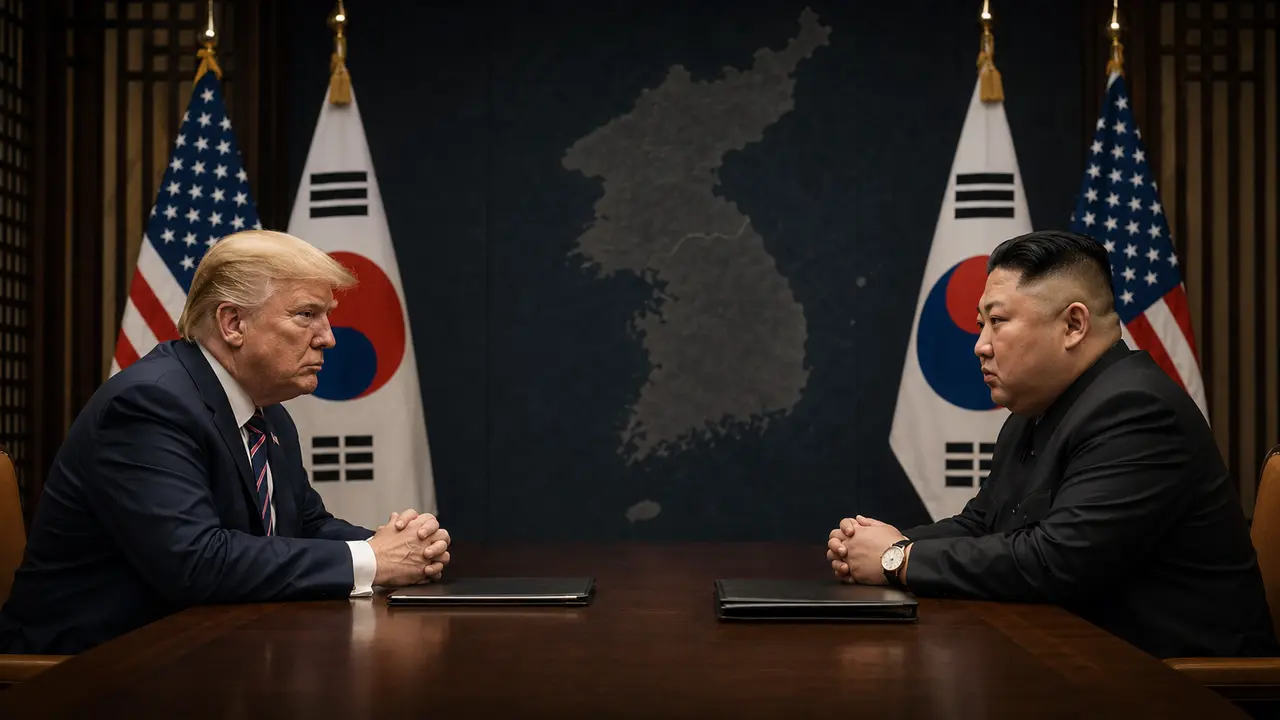
President Donald Trump says he intends to meet North Korean leader Kim Jong Un again before the end of the year. That prospect will predictably produce two bad reactions in Washington: one camp will treat the meeting itself as proof of diplomatic genius, while another will condemn any conversation with a dictator as appeasement.
Neither standard is serious enough for the nuclear threat confronting the United States and its allies.
Presidents should talk to adversaries when direct communication can reduce the risk of war or produce a verifiable agreement. Trump’s willingness to meet Kim during his first term broke through a diplomatic freeze and created personal access no recent president had possessed. It also demonstrated that Trump was willing to walk away at Hanoi in 2019 when North Korea sought major sanctions relief without offering enough nuclear dismantlement in return.
That was the correct decision then. It should remain the standard now.
A summit is not an achievement. It is a tool. The question is what America receives in exchange for the legitimacy, attention and leverage Kim gains by sitting across from an American president.
North Korea enters these talks stronger than it was in 2019
Trump’s earlier diplomacy did not produce denuclearization. Since those meetings, North Korea has expanded its weapons programs and deepened its relationships with Russia and China.
The Stockholm International Peace Research Institute estimated this year that North Korea may have assembled roughly 60 nuclear warheads and possesses enough fissile material for at least 30 more. The exact number is uncertain because the regime is closed and inspections are limited, but the direction is not uncertain: Kim has more nuclear leverage than he did when he first met Trump in Singapore.
Pyongyang is also less isolated. Its growing military relationship with Moscow gives Kim additional economic and strategic support, reducing the urgency he once felt to obtain sanctions relief from Washington. That changes the bargaining table. Personal rapport may reopen a door, but it cannot reverse the balance on its own.
Kim’s sister and senior official Kim Yo Jong offered a cool response to Trump’s latest outreach. She acknowledged the personal history between the two leaders but signaled that North Korea sees little reason to return to negotiations if Washington’s position remains centered on denuclearization. Pyongyang has not formally closed the door, but it is making clear that nostalgia for the 2018 summit is not enough.
That is precisely why the United States should prepare a detailed negotiating position before scheduling another televised encounter.
The exercise reduction risks giving away leverage early
Trump recently directed the Pentagon to substantially reduce joint military exercises with South Korea, citing their cost and the message they send to North Korea. The allies subsequently shortened their annual exercise from 11 days to five and scaled back portions of field training.
There is a legitimate debate about the size, cost and frequency of military exercises. Every overseas commitment should be reviewed against American interests, and allies should carry a fair share of their defense burden.
But exercises are not merely political theater. They are how American and South Korean forces test communications, command structures, missile defense and their ability to respond during a crisis. Reducing them before North Korea accepts inspections, freezes production or limits missile testing risks converting American leverage into an advance payment.
Trump has long believed that bold personal diplomacy can unlock agreements traditional negotiators cannot reach. Sometimes it can. Yet a leader who prides himself on not paying before delivery should apply that instinct here.
If Kim wants fewer exercises, sanctions relief, diplomatic recognition or economic access, he should provide something measurable first.
What America should demand
A realistic agreement does not require believing that Kim will surrender every warhead in one dramatic ceremony. It does require refusing to pretend that vague promises are progress.
The first objective should be a verified freeze on the production of weapons-grade nuclear material. International inspectors need declared access to relevant facilities, along with a system for resolving undeclared or suspicious sites. A freeze that cannot be inspected is a press release, not an agreement.
Second, North Korea should halt long-range missile tests and provide verifiable limits on the systems capable of reaching the United States. Shorter-range missiles also matter because they threaten South Korea and Japan; Washington cannot purchase temporary safety for the American homeland by leaving allies exposed.
Third, sanctions relief should be phased and reversible. Each economic concession should follow a completed North Korean action, not a future promise. If Pyongyang cheats or blocks inspectors, the relief should snap back without requiring a new round of negotiations at the United Nations.
Fourth, South Korea and Japan must be fully consulted. The United States does not need to give allies veto power over American foreign policy, but it should not surprise the countries that would absorb the first missiles in any renewed conflict. Alliance distrust is itself a strategic gift to China and North Korea.
Finally, the administration should pursue practical risk-reduction measures even if a comprehensive nuclear agreement remains out of reach: military hotlines, notification procedures, recovery of American remains and humanitarian arrangements that do not place cash directly under regime control.
Diplomacy backed by strength
There is a strong case for direct diplomacy. Strength is not measured by refusing to enter a room. Ronald Reagan negotiated with the Soviet Union while rebuilding American military power because he understood that deterrence and dialogue serve different parts of the same strategy.
But there is also a warning that should be familiar on the right. Dictators use summits to elevate their standing, divide alliances and buy time. Kim has shown that he can pocket symbolic concessions while continuing the programs at the center of the dispute.
Trump’s strongest moment in the previous negotiations was not the Singapore handshake. It was his decision to leave Hanoi without a weak deal.
If another summit occurs, the administration should define success before the cameras arrive. Success is not warmer language, another exchange of letters or an indefinite promise to keep talking. It is fewer weapons, less fissile material, more inspection access and a lower measurable risk to Americans and their allies.
The president should meet Kim if his national security team believes the meeting can advance those goals. He should also be prepared to cancel it—or walk away again—if North Korea expects the prestige of diplomacy without the obligations of an agreement.
America can talk without surrendering. The difficult part is remembering that the conversation is the beginning of the negotiation, not the victory photograph at its end.
Sources
- Reuters: Trump says he plans to meet Kim this year
- Reuters: North Korea offers a cool response to renewed outreach
- Reuters: Trump directs reduction of U.S.–South Korea exercises
- Reuters: United States and South Korea shorten annual drills
- SIPRI: 2026 world nuclear forces assessment
- Congressional Research Service: The 2019 Hanoi summit