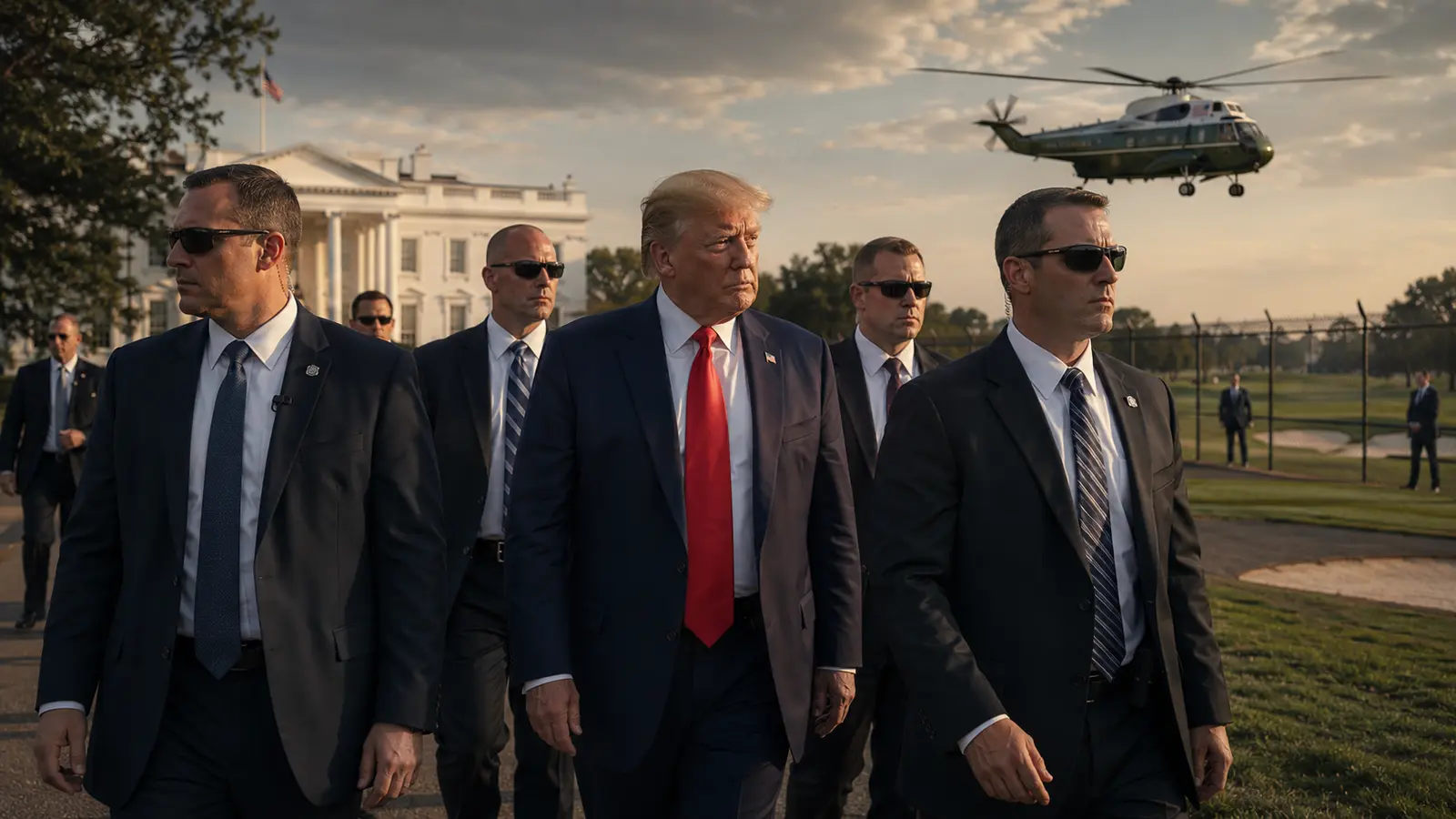
On August 5, security personnel at Trump National Golf Club Los Angeles noticed a man wearing an earpiece and photographing federal agents before President Donald Trump was expected at the property for a Republican event.
Police arrested Jeanine John Taele, a 38-year-old former Marine, and said they found a loaded 9mm pistol, ammunition, binoculars and what appeared to be security equipment. Prosecutors later said more than 200 pages of writings recovered in the investigation included detailed schedules involving First Lady Melania Trump and members of the Secret Service.
Those facts point toward something potentially far more serious than an ordinary weapons violation. An armed man was allegedly monitoring federal agents shortly before Trump’s arrival, and investigators say his writings contained detailed schedules involving Melania Trump and members of the Secret Service. Taken together, the weapon, surveillance behavior and schedule information give authorities—and the public—substantial reason to suspect that security may have interrupted preparations for another attack before the plan could be carried out.
That possibility should not be downplayed. It also has not been proven in court. Taele has not been charged with attempting to kill the president or first lady, and prosecutors have not publicly established his intended target or motive. A judge suspended the criminal proceedings and ordered a mental-competency evaluation, while his attorney has cautioned against reaching conclusions before the evidence is tested.
The most honest description lies between dismissal and certainty: this was an armed pre-event security intervention containing several apparent signs of surveillance and preparation. It may ultimately prove to have been a fourth assassination attempt. Until investigators establish that intent and prosecutors bring the corresponding charge, it should be treated as a serious suspected assassination plot—not reported as a legally established fourth attempt.
Since the July 2024 shooting in Butler, Pennsylvania, the country has seen a second gunman conceal himself along a Trump golf course, an armed attacker storm the venue hosting the White House Correspondents’ Association Dinner, a shotgun-carrying intruder breach Mar-a-Lago’s perimeter, and gunmen exchange fire with officers near the White House.
There have also been security lapses that did not involve a proven hostile plot: a loaded handgun missed during screening at a Trump golf club, an armed off-duty police officer accused of passing himself off as presidential security at the Ryder Cup, a suspicious hunting stand with a clear view of the Air Force One parking area, a laser pointed at Marine One, and a communications breakdown that failed to stop a commercial jet from departing as the presidential helicopter lifted from the Ellipse.
At the same time, the United States has confronted alleged Iranian murder-for-hire plots and a reported threat serious enough that Trump secretly switched aircraft in Turkey while Air Force One continued as a decoy.
The pattern is not that every unusual person near Trump is an assassin. The pattern is that the system protecting the president is operating under extraordinary pressure, often at venues with vulnerabilities the government does not fully control. Sometimes that system has failed badly. Sometimes it has detected and defeated a threat. Sometimes the public still does not know enough to judge.
The right response is neither panic nor reflexive praise. It is accountability grounded in facts.
Butler was the failure no one can explain away
The standard begins with Butler because the government’s own investigations established what happened there.
On July 13, 2024, Thomas Matthew Crooks climbed onto a roof outside the main security perimeter at a campaign rally, obtained a direct line of sight to Trump and opened fire. A bullet struck Trump’s ear. Corey Comperatore was killed while shielding his family, and two other rallygoers were seriously wounded before a Secret Service counter-sniper killed Crooks.
Congressional and internal reviews documented a cascade of preventable failures: poor advance planning, an inadequately secured roof, fragmented communications, information that did not move quickly enough, and confusion over who was responsible for what.
Local officers had identified Crooks as suspicious well before the shooting. The protective system possessed pieces of the threat picture but failed to assemble them in time.
That is not a partisan interpretation. It is the conclusion reached in official reviews. Secret Service Director Kimberly Cheatle resigned, agents were later suspended, and the agency began implementing dozens of reforms.
The agents who rushed onto the stage and covered Trump after the first shot displayed courage. That bravery does not erase the organizational failures that allowed the shooter to fire in the first place. A serious country should be capable of recognizing both truths at once.
Routh showed why golf courses remain a hard target
Two months later, on September 15, 2024, a Secret Service agent advancing one hole ahead of Trump at Trump International Golf Club in West Palm Beach spotted the barrel of a rifle protruding through the fence line.
Ryan Wesley Routh had concealed himself in vegetation outside the course. Investigators said he had been there for hours. The agent fired toward him, and Routh fled without firing at Trump. Police captured him on Interstate 95. A jury later convicted him, and he received a life sentence.
Unlike Butler, the immediate protective action worked. The advance agent saw the threat before Trump came into the gunman’s view and forced the suspect to abandon the position.
But the episode exposed a structural problem that has never disappeared: golf courses are sprawling, open and difficult to seal. Public roads, tree lines and adjoining property can offer long sight lines into predictable areas. A president who frequently plays at his own clubs presents security planners with a repeated pattern that hostile actors can study.
That does not mean Trump must surrender ordinary parts of his life to anyone holding a rifle. It does mean protectee preference cannot substitute for security judgment. If a location cannot be made acceptably secure, schedules, routes, sight lines and public access must change—even when those changes are inconvenient.
Small lapses reveal how layers can fail
The less dramatic incidents may be the most useful for prevention because they show how an attacker could exploit routine assumptions.
In August 2025, a member at Trump National Golf Club Washington, D.C., in Virginia passed through screening while carrying a loaded Glock in a bag. The member later reported the forgotten weapon. The Secret Service said the gun did not come near Trump, placed the screener on administrative leave and began a review.
There was no known assassination plot. The person’s decision to report the firearm may have prevented the lapse from remaining hidden. But the point of screening is to stop a weapon before it crosses the protective perimeter—not to depend on the person carrying it to disclose the failure.
The following month, an off-duty New York City police detective allegedly entered the Ryder Cup at Bethpage Black in tactical gear while Trump was attending, falsely presenting himself as part of a security detail. Reports said the deception was discovered after a gun magazine fell from his equipment. The NYPD suspended him.
Again, there is no public evidence that the officer intended to harm Trump. The incident matters because impersonating authorized security is a classic way to defeat a protective perimeter. Credentials, assignments and identities must be verified, not assumed because someone has the right uniform and professional vocabulary.
Also in September 2025, a man near the White House was charged with aiming a laser at Marine One while Trump was aboard. The beam could have temporarily disoriented a pilot, though the court filing did not say anyone aboard noticed it. A Secret Service officer witnessed the act and arrested the suspect.
These were not assassination attempts. They were warnings about ordinary weaknesses: inconsistent screening, visual trust and the difficulty of controlling the environment around a moving aircraft.
The hunting stand raised questions that remain unanswered
In October 2025, agents conducting an advance sweep near Palm Beach International Airport found an unmanned hunting stand with a direct view of the area where Air Force One parks during presidential visits.
No firearm or person was found at the structure. The FBI investigated how long it had been there and whether it represented a threat. No public evidence has established that it was placed as part of an assassination plan.
Calling it a proven sniper position would outrun the facts. Dismissing it as harmless would be just as careless.
A concealed elevated position overlooking a predictable presidential arrival point is precisely the kind of anomaly advance teams are supposed to identify. The discovery shows the sweep worked. The unanswered question is whether the structure had existed through earlier visits and, if so, why it was not detected sooner.
Armed confrontations reached the presidential perimeter
On February 22, 2026, a 21-year-old man drove through an opening in the secure perimeter at Mar-a-Lago as another vehicle was leaving. Authorities said he carried a shotgun and a fuel can. When confronted by two Secret Service agents and a local deputy, he raised the weapon and was shot and killed.
Trump was in Washington at the time. Investigators had not publicly established an assassination motive, and relatives described the man as a Trump supporter who had recently been reported missing.
The breach was real even if the motive was not political. It also demonstrates why physical security has to work independently of motive. Agents at a checkpoint cannot wait for a psychological profile when an armed person has crossed a protected boundary and raises a shotgun.
Three months later, the White House area saw two separate gunfights.
On May 4, plainclothes officers spotted an armed man near the Washington Monument shortly after Vice President JD Vance’s motorcade had traveled nearby. Prosecutors said the man fled, drew a weapon and fired toward a Secret Service agent before officers returned fire. A bystander was wounded. Authorities did not publicly identify a presidential assassination motive.
On May 23, a different gunman approached a White House checkpoint, removed a firearm from a bag and opened fire. Secret Service officers shot him, and he later died. A bystander was also wounded. Trump was inside the White House and unharmed.
These confrontations show protective officers identifying and stopping armed danger at the outer edge. They also raise a separate issue: defensive gunfire around crowded public spaces can injure people even when officers act to stop a legitimate threat. Training, fields of fire, checkpoint design and pedestrian control all matter.
The Washington Hilton became the third major attempt
The most serious post-Butler breach occurred on April 25, 2026, at the White House Correspondents’ Association Dinner.
Prosecutors say Cole Tomas Allen arrived at the Washington Hilton armed with a shotgun, a handgun and knives, ran past an outer security point and fired while moving toward the ballroom where Trump, Melania Trump, Vice President JD Vance and senior officials were gathered. A Secret Service agent was struck in his protective vest. Other agents subdued Allen, and the president and guests were evacuated safely.
Allen has pleaded not guilty and is entitled to the presumption of innocence. A federal indictment charges him with attempting to assassinate the president and assaulting a federal officer. Investigators said he had booked a room at the hotel weeks earlier and sent writings indicating an intention to target Trump administration officials.
The response inside the venue prevented the attack from reaching the ballroom. The outer perimeter did not prevent an armed hotel guest from getting close enough to open fire.
That is the central tension running through this record: individual agents repeatedly demonstrate courage and speed after encountering the threat, while planners sometimes leave an avoidable path for the threat to reach them.
The Washington Hilton was also the site where John Hinckley Jr. shot President Ronald Reagan in 1981. Its layout and public-access challenges were not unknown. If the president attends a venue that cannot be secured to White House standards, officials must compensate with stronger guest screening, hotel-room controls, interior barriers and verified movement corridors.
Tradition and media spectacle do not outrank presidential security.
The newest golf-course arrest is disturbing—but still unresolved
The August 2026 arrest at Trump’s Los Angeles golf course returns the story to a familiar vulnerability.
According to prosecutors, Taele had a loaded pistol, ammunition, binoculars, an earpiece and extensive writings that included schedules involving the first lady and Secret Service personnel. Staff reported suspicious behavior before Trump arrived, allowing law enforcement to intervene without a confrontation.
Those are significant facts. So are the limits of the case.
The criminal proceedings were paused for a mental-competency evaluation. Prosecutors have not charged Taele with attempting to harm Trump or Melania Trump, and the defense disputes sinister interpretations of the evidence.
The incident should therefore be described as an armed pre-event security intervention involving possible surveillance—not as a proven plot. Security personnel deserve credit for noticing behavior that did not fit the setting and acting before the president reached the property.
That is what layered protection is supposed to accomplish.
Iran has changed the threat environment
Domestic gunmen are only part of the burden.
Federal prosecutors have pursued multiple alleged Iranian plots against Trump. In one case, the Justice Department charged Farhad Shakeri, an alleged Islamic Revolutionary Guard Corps asset, in connection with a murder-for-hire plan. Prosecutors said Shakeri reported being directed in October 2024 to develop a plan to kill Trump. He remained at large in Iran when the charges were announced.
In another case, a federal jury convicted Asif Merchant in March 2026 for participating in an Iran-linked murder-for-hire scheme. The government said Merchant sought people who could carry out killings of U.S. officials and political figures.
The most striking protective response came during Trump’s 2026 trip to Turkey. Amid intelligence about a possible shoulder-fired missile or assassination threat, the president reportedly transferred secretly from Air Force One to a smaller Air Force aircraft while the presidential jet continued as a decoy. Trump later confirmed the aircraft switch. Reporting also indicated that some U.S. intelligence officials questioned the threat’s credibility.
Whatever the final intelligence assessment, this is an example of the security system taking a possible threat seriously and adapting before an attack occurred. Not every item in the record is a failure.
Iranian state media has since aired a video appearing to threaten Barron Trump, and the Secret Service said it was aware of it. Iranian officials denied an assassination plan. Threatening propaganda is not proof of an operational plot, but it adds to the protective-intelligence workload surrounding the president’s family.
Marine One was a system failure, not a Secret Service failure
The August 4 Marine One incident belongs in this broader story with an important warning: no public evidence identifies it as a Secret Service mistake or a hostile act.
Marine One departed a temporary landing site on the Ellipse with Trump aboard after its crew twice attempted to provide Reagan National Airport with the required three-minute warning. One call was not received. Another was unreadable. An attempted relay through Joint Base Anacostia-Bolling also failed.
Because the tower never received an intelligible warning, it cleared an Envoy Air regional jet for departure. The helicopter crew saw the aircraft and briefly delayed. The two flights remained separated, and no collision-avoidance maneuver was ordered.
The disturbing fact is not that the aircraft were proven to be seconds from impact; the preliminary report does not say that. It is that the special procedure designed to protect a presidential movement failed even though HMX-1 and air traffic personnel had discussed spotty radio coverage days earlier.
The FAA later determined that the temporary Ellipse location lacked adequate line of sight to the radio receiver, moved the equipment to Reagan National’s tower and revised procedures.
This was a breakdown involving Marine aviation, the FAA, air traffic control and White House operating arrangements. It shows why presidential protection cannot be measured solely by the Secret Service. The president depends on an interlocking system of agents, military units, pilots, controllers, local police, intelligence agencies and venue operators. A weak link anywhere in that chain can defeat a safety layer.
Three officials on leave—and facts the public does not yet have
The Secret Service confirmed in late August that three non-law-enforcement employees had been placed on administrative leave while its Office of Professional Responsibility investigated possible misconduct.
The agency has not publicly explained what conduct is under review. That means there is no factual basis to connect those employees to Butler, the Washington Hilton, the Los Angeles golf-course arrest or the reported Iranian threat.
Their status can be mentioned because it bears on public confidence in the agency. It cannot honestly be used as proof of a wider conspiracy or specific operational failure unless investigators release evidence supporting that conclusion.
Accountability requires disclosure. It also requires restraint while the facts remain incomplete.
What genuine reform should look like
The temptation after each incident is to demand more agents, higher fences and another classified review. Some of that may be necessary. But the recurring problems point toward practical reforms that can be judged publicly.
First, advance work must include hostile-site thinking. Roofs, tree lines, hotel rooms, elevated stands, adjoining roads and temporary construction should be assessed from the attacker’s perspective, not merely checked against a standard list.
Second, responsibility must be unmistakable. Butler showed what happens when federal and local teams assume someone else owns a vulnerability. Every position, perimeter and response function needs one named authority with the power to fix or halt the event.
Third, communications must be tested under real operating conditions. A radio procedure is not ready because it worked from another helipad or during a meeting. Primary and backup channels must be demonstrated from the actual site before the president moves.
Fourth, credentials and screening need independent quality checks. A loaded firearm missed in a bag and an armed person allegedly posing as security are not harmless embarrassments. They reveal methods a determined attacker could copy.
Fifth, difficult venues require difficult decisions. Golf courses, convention hotels and outdoor rallies are part of American political life, but no protectee is entitled to override a professional judgment that a location cannot be secured. Presidential accessibility is valuable. Presidential survival is indispensable.
Finally, Congress should demand measurable progress rather than televised blame. How many Butler reforms are complete? How often are temporary sites red-teamed? How are local communications tested? What changes followed the Washington Hilton breach? Those answers can be provided without publishing tactical details that would help an attacker.
Respect the agents. Audit the system.
Trump’s supporters should not have to choose between respecting the men and women who protect him and demanding accountability from their leadership.
At Butler, agents shielded the former president after a preventable failure had already placed him in the line of fire. At the West Palm Beach golf course, an advance agent detected Routh before he could shoot. At the Washington Hilton, officers confronted an armed attacker outside the ballroom. At the Los Angeles golf club, suspicious conduct was recognized before Trump arrived. In Turkey, planners changed aircraft amid a possible foreign threat.
Those successes are real.
So are the roof left unsecured in Butler, the outer security layer breached at the Hilton, the handgun missed during club screening, the suspicious sight line near Air Force One and the known radio weakness that defeated Marine One’s departure procedure.
The patriotic position is not to declare the system flawless because Trump survived. It is to insist that courage on the ground be matched by competence above it.
America cannot eliminate every threat against a president. It can eliminate preventable failures, learn from near misses before they become tragedies and stop confusing a successful last-second response with a fully successful security plan.
The next test will not look exactly like Butler, Routh or the Washington Hilton. That is why the government must learn the pattern instead of preparing only to replay the last attack.
Sources
- FBI: Butler investigation updates
- U.S. Senate: Examination of Secret Service planning and security failures at Butler
- U.S. Secret Service: Mission Assurance Investigation into the Butler assassination attempt
- Reuters: Senate report finds a cascade of preventable failures at Butler
- Justice Department: Ryan Routh indicted for attempting to assassinate Trump
- Straight Arrow News: Secret Service review after a loaded gun passed golf-club screening
- Fox News: Armed off-duty detective accused of posing as security at the Ryder Cup
- Associated Press: Man charged with aiming a laser at Marine One
- Scripps News: Hunting stand found with a view of the Air Force One parking area
- Associated Press: Armed man killed after breaching Mar-a-Lago’s secure perimeter
- Justice Department: Michael Marx charged in shooting at a Secret Service agent near the Washington Monument
- Associated Press: Gunman killed after opening fire at a White House checkpoint
- Justice Department: Cole Tomas Allen charged in White House Correspondents’ Dinner shooting
- Associated Press: Security questions after the White House Correspondents’ Dinner attack
- Associated Press: Former Marine arrested armed at Trump’s Los Angeles golf course
- Justice Department: Charges against an alleged IRGC asset in plot targeting Trump
- Justice Department: Asif Merchant convicted in Iran-linked murder-for-hire plot
- Reuters: Reported Iranian threat led to Trump’s secret aircraft switch in Turkey
- Reuters: Secret Service aware of Iranian video appearing to threaten Barron Trump
- NTSB: Preliminary report on the Marine One air-traffic incident
- Associated Press: White House construction contributed to the Marine One radio problem
- Associated Press: Three Secret Service officials placed on administrative leave