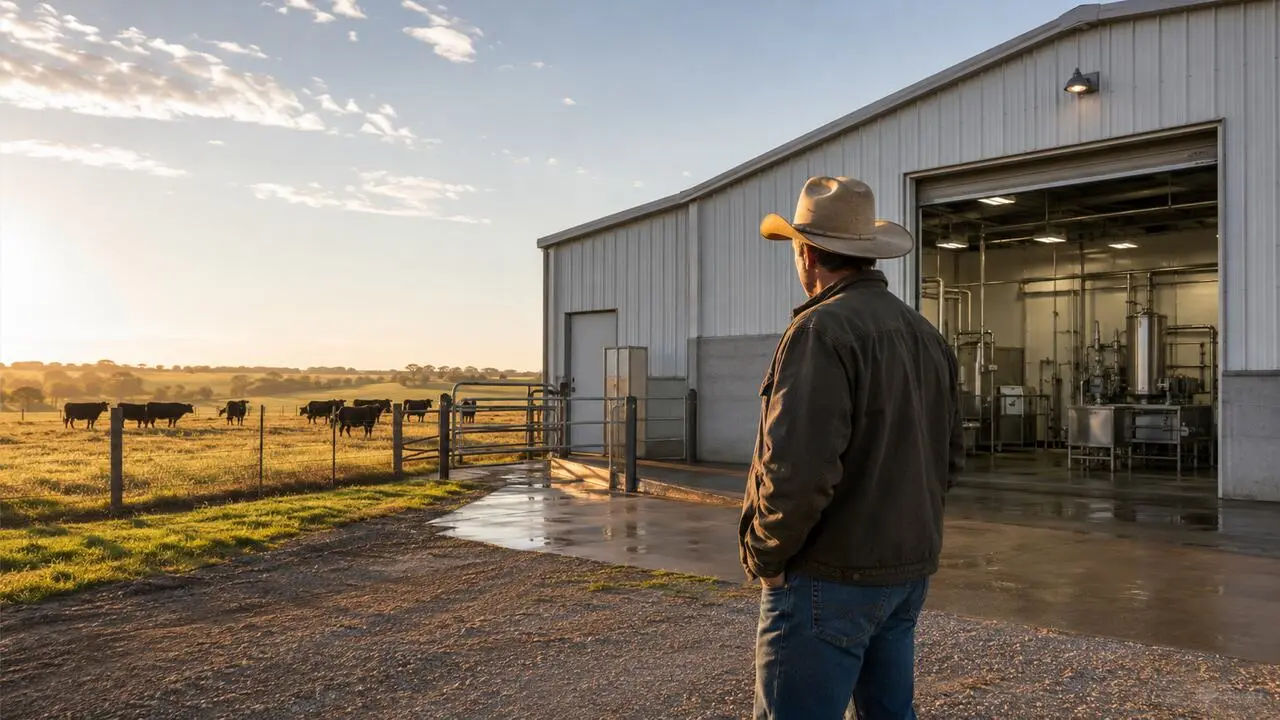
President Donald Trump says his administration is preparing a legal order intended to give American farmers and ranchers greater authority to process their own food and reduce their dependence on the country's dominant meatpackers.
Trump announced the move Friday while accusing the largest processors of operating what he called a “nasty monopoly.” He said legal documents would be drawn quickly, but the White House had not released an executive order or detailed regulatory text as of Friday afternoon.
Agriculture Secretary Brooke Rollins said the administration is preparing additional actions involving beef processing, smaller facilities, interstate sales and federal regulations that make it difficult for independent producers to bring meat directly to market.
The basic goal deserves serious attention. America's beef-processing system is extraordinarily concentrated, leaving ranchers with relatively few buyers and consumers vulnerable when a major plant closes or a supply-chain disruption hits. But the final policy will have to do more than promise that ranchers can “process their own food.” It must define who can sell that meat, where it can be sold and what inspection standards will protect the public without crushing small operators.
Four companies dominate beef processing
The concentration problem is not imaginary.
Cargill, Tyson Foods, JBS USA and National Beef Packing control roughly four-fifths of the market for slaughtering steers and heifers. USDA reports have placed the four-firm share between approximately 81% and 85% in recent years.
That concentration gives the largest packers enormous influence between the ranch and the grocery store. Ranchers often operate in markets with only a small number of realistic buyers, while consumers encounter prices shaped by a processing system in which disruption at a handful of plants can affect the entire country.
Large processing plants can achieve efficiencies that small facilities cannot easily match. Concentration alone does not prove illegal price-fixing, and breaking regulatory barriers will not automatically cut grocery prices. But a system this dependent on four companies is less competitive and less resilient than it should be.
The COVID-era plant shutdowns made that vulnerability visible. When major facilities slowed or closed, cattle backed up on farms while retail meat supplies tightened. Producers and consumers both suffered even though livestock still existed and demand for meat remained strong.
More local and regional processing would not replace the large packers. It could, however, give producers additional options, create competition in underserved regions and reduce the damage caused by bottlenecks at giant plants.
What farmers can do now—and what they generally cannot
Federal law already allows an owner to have an animal slaughtered and processed under a custom exemption for the owner's household, guests and employees. That meat is not the same as federally inspected commercial product and generally cannot be sold to the public.
Meat intended for ordinary commercial sale must satisfy federal or qualifying state inspection requirements. Interstate commerce adds another layer. State-inspected plants generally sell within their own states unless they participate in USDA's Cooperative Interstate Shipment program or operate under federal inspection.
Those rules serve a legitimate purpose. Slaughter and meat processing can introduce dangerous pathogens if facilities lack sanitation, testing, temperature control and professional inspection. Consumers should not have to guess whether beef at a market was produced under meaningful safety standards.
But safety rules can also become barriers to entry when compliance systems are designed around the staffing, paperwork and capital of enormous plants. A requirement that is manageable for a multinational processor can be economically impossible for a family ranch or a small regional butcher—even when the small operator can produce safe food.
That is the balance the administration must get right.
What Trump may be able to change without Congress
The president can direct USDA to review regulations, accelerate approvals, expand technical assistance and reconsider guidance that unnecessarily burdens small processors. The department may also be able to make greater use of cooperative inspection programs and reduce administrative barriers that prevent qualifying state-inspected facilities from selling across state lines.
The administration can support new regional plants, improve access to inspectors and examine whether enforcement practices treat small facilities proportionately. It can also continue antitrust scrutiny of dominant packers and challenge conduct that violates competition law.
But an executive order cannot simply erase federal statutes. If Trump's plan would allow custom-exempt meat to be sold broadly across state lines without the inspection structure Congress required, lawmakers may have to change the law.
That is why the legal text matters. “Process their own food” could describe several very different policies: on-farm slaughter for direct local sales, expanded state inspection, mobile processing units, broader interstate eligibility or a sweeping exemption from existing rules. Each approach carries different legal and safety consequences.
Until the order is released, claims that Trump has already abolished federal inspection—or that ranchers will immediately be free to sell self-processed meat nationwide—go beyond the available facts.
Competition and food safety are not opposing goals
Industry groups have responded cautiously. Supporters of smaller processors welcome relief from rules that block competition, while cattle and meat-industry organizations warn that changes must preserve credible inspection and food-safety protections.
That should not be treated as an excuse for inaction. It should be treated as the design requirement.
America does not have to choose between four dominant meatpackers and an unregulated free-for-all. A serious reform could create scaled inspection standards, expand mobile and regional processing, recognize qualified state programs and allow direct sales without abandoning traceability or sanitation.
Small processors should have a path to market that is demanding enough to protect families but realistic enough to use. If only billion-dollar companies can comply, regulation stops functioning solely as a safety system and begins protecting incumbents from competition.
Conservatives should support decentralization here for the same reason they support it elsewhere: decisions made closer to producers and consumers are often more responsive, more resilient and less vulnerable to centralized failure. But decentralization works only when responsibility travels with freedom. Producers who sell food to the public must remain accountable for its safety.
The questions the final order must answer
The administration's announcement creates an opportunity. Whether it becomes durable reform will depend on the details.
The final plan should answer at least five questions:
- What inspection standard will apply to meat processed on farms or at small independent facilities?
- Will qualifying products be eligible for interstate sale, and under what legal authority?
- How will USDA expand inspector access so small plants are not approved on paper but stranded in practice?
- Will the administration help finance regional and mobile processing capacity, or only reduce paperwork?
- How will antitrust enforcement address dominant packer conduct while preserving the productive capacity large plants provide?
If Trump uses this initiative to create more lawful pathways for ranchers, expand regional capacity and challenge genuinely anti-competitive conduct, the result could strengthen both producers and consumers.
If the final order merely substitutes a slogan for workable inspection and market rules, it will not break the industry's concentration.
The country needs more competition, more processing capacity and more resilient local supply chains. It also needs safe food. The administration's task is to prove those goals can reinforce one another.
Sources and further reading
- Reuters: Trump vows legal order to break up food-processing “nasty monopoly”
- White House: Administration action concerning foreign-owned meatpacking concentration
- USDA FSIS: Custom Exempt Review Process
- USDA FSIS: Cooperative Interstate Shipment Program
- USDA: Packers and Stockyards 2021–2022 Report to Congress
- Agriculture.com: Trump says he will examine beef-processing regulations