
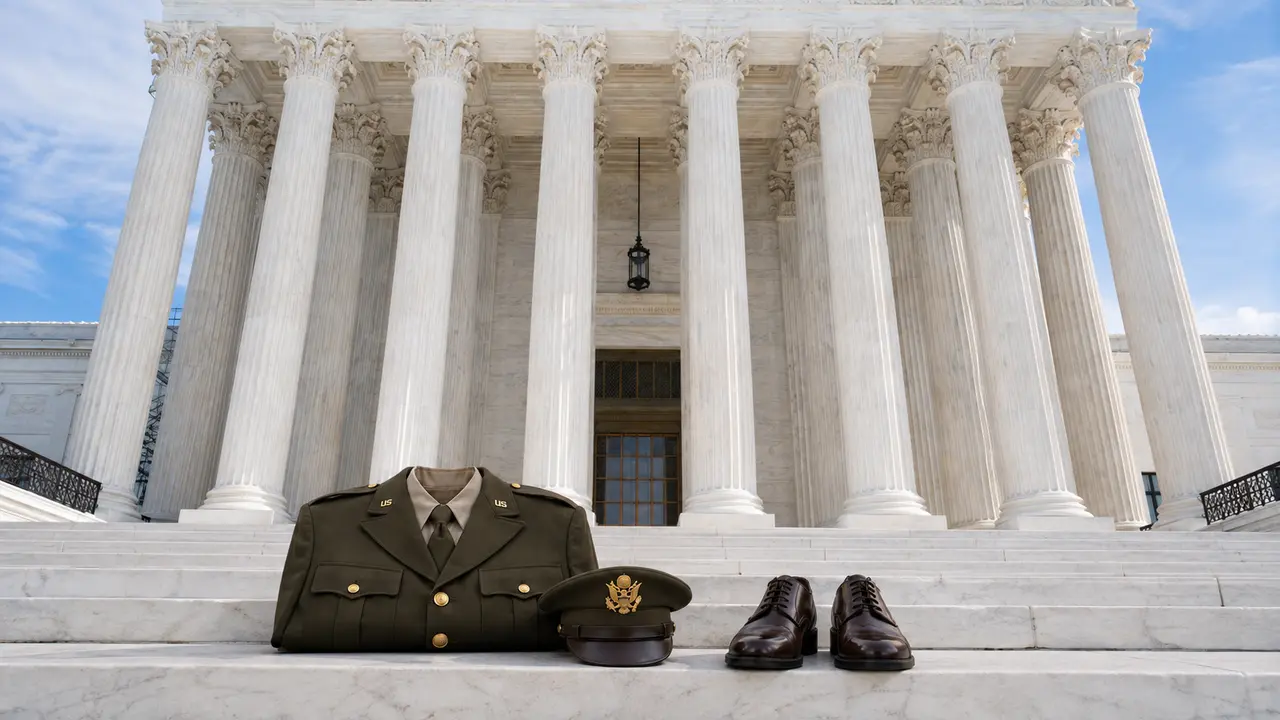
The Trump administration has asked the Supreme Court to decide whether the Pentagon may generally disqualify people with gender dysphoria, a history of the diagnosis or a history of related medical interventions from military service.
The petition filed August 28 seeks review of a divided D.C. Circuit decision that stopped the government from discharging currently serving plaintiffs while allowing restrictions on new accessions to continue. Since that appellate ruling, the district court has certified a class that includes transgender service members covered by the lawsuit.
The case, United States v. Talbott, puts two serious principles in direct tension. The Constitution assigns elected leaders and military commanders broad responsibility for organizing the armed forces and setting readiness standards. But that authority remains subject to the Fifth Amendment’s guarantee of equal protection, and courts have held that military deference is not a blank check for unsupported discrimination.
The Supreme Court has allowed a similar policy to operate during separate litigation, but it has not issued a full merits ruling on the constitutionality of the current policy. The new petition asks the justices to take that question now, before a two-week trial scheduled to begin January 4.
What the administration is asking
Solicitor General D. John Sauer frames the issue as whether the Pentagon policy violates the equal-protection component of the Fifth Amendment’s Due Process Clause.
The government argues that the policy regulates a medical diagnosis and related treatments rather than transgender status itself. Under that theory, the rule should receive rational-basis review—the Constitution’s most deferential standard—and should survive because military leaders connected it to deployability, readiness, physical and mental standards and unit effectiveness.
The petition also invokes the Supreme Court’s long history of deferring to professional military judgments. Courts ordinarily lack the expertise and operational responsibility of commanders who must prepare forces for war, the government argues. It says the D.C. Circuit improperly substituted judicial judgment for the Pentagon’s assessment of who may serve.
Those are legal arguments, not established facts. Granting review would not mean the Supreme Court has accepted them, and the filing itself does not change the current injunction.
What the lower court decided
The D.C. Circuit’s June 1 opinion split the case between new applicants and personnel already serving.
The 2-1 majority allowed the Pentagon to continue barring new transgender accessions while litigation proceeds. The court found that delaying entry into the armed forces imposed a smaller immediate harm and recognized the Pentagon’s broad authority to establish initial qualifications.
For currently serving plaintiffs, however, the majority preserved the injunction against discharge. It concluded that ending established military careers created a more serious injury and that the plaintiffs were likely to succeed on their equal-protection challenge.
The majority emphasized language in President Trump’s January 2025 executive order and later Pentagon documents that characterized gender identity in moral as well as medical terms. It also noted that the government did not dispute the named service members’ records: collectively, they had served for roughly 130 years and earned more than 80 commendations.
Judge Justin Walker dissented. He argued that the judiciary should defer to military leaders and warned that civilian judges lack both the constitutional role and institutional competence to decide personnel rules for the armed forces.
The policy and its exceptions
The February 2025 policy generally disqualifies individuals with a current diagnosis or history of gender dysphoria, symptoms consistent with the condition or a history of certain gender-transition interventions. It applies differently to accession and retention and includes a waiver process.
The government describes the rule as comparable to other medical standards that disqualify many applicants unless they receive waivers. Its petition notes that the military screens for hundreds of conditions and estimates that most Americans ages 17 to 24 would need some form of waiver to enlist.
The plaintiffs argue that the waiver is too narrow to provide a meaningful exception and that the policy uses gender dysphoria as a proxy for excluding transgender people. Their attorneys also point to the individual service records as evidence that categorical removal is not tied to actual performance.
Neither characterization should be treated as a final judicial conclusion. The government’s readiness rationale is its litigating position. The plaintiffs’ discrimination claim is also a legal claim. The lower courts have made preliminary findings, but the scheduled trial has not occurred and the Supreme Court has not ruled on the merits.
Why the earlier Supreme Court order does not settle this case
In May 2025, the Supreme Court allowed the administration to implement the policy while a separate case, United States v. Shilling, continued in Washington state. The unsigned order did not explain the justices’ reasoning and did not decide whether the policy is constitutional.
The government says that intervention supports review in Talbott and demonstrates the importance of uniform military policy. The D.C. Circuit majority said the earlier order did not control because the two cases reached the Court in different procedural postures. Walker’s dissent viewed the earlier action as a strong signal that judges should not preserve the Talbott injunction.
That disagreement is one reason the new petition matters. The Court can deny review, grant the petition and hear the merits or potentially narrow the issue. Until it acts, current orders remain in place.
Readiness requires standards—and evidence
The armed forces are not an ordinary workplace. Commanders must impose standards that would be impermissible or impractical in civilian life. Deployability, medical reliability, physical fitness, discipline, privacy, unit cohesion and combat effectiveness are legitimate concerns.
But a serious readiness policy must connect its classifications to measurable military requirements. The public record creates a factual dispute over that connection. The administration says the diagnosis and associated treatments create risks the military may address categorically. The plaintiffs say their service histories show that current personnel can be evaluated through the same performance and deployability standards applied to everyone else.
Cost is also frequently invoked, but neither slogans about taxpayer expense nor assertions of discrimination can replace a transparent accounting. Congress and the Pentagon should provide current data on treatment costs, time away from duty, waiver decisions, retention losses, separation expenses and the cost of replacing trained personnel.
What happens next
The plaintiffs will have an opportunity to oppose the petition. Four justices must vote to hear the case. If review is granted, briefing and oral argument would place the constitutional merits before the Court. If review is denied, the case returns to the district court for trial under the existing schedule.
The question is larger than a single administration’s preferred terminology. It concerns how far courts should defer when military leaders invoke readiness—and what evidence the Constitution requires when a policy removes people who have already met the service’s standards.
The Supreme Court should receive the complete record, and the public should insist that both sides distinguish operational evidence from political rhetoric. Military policy must be lawful, consistently applied and directed toward producing the most capable fighting force the country can field.