
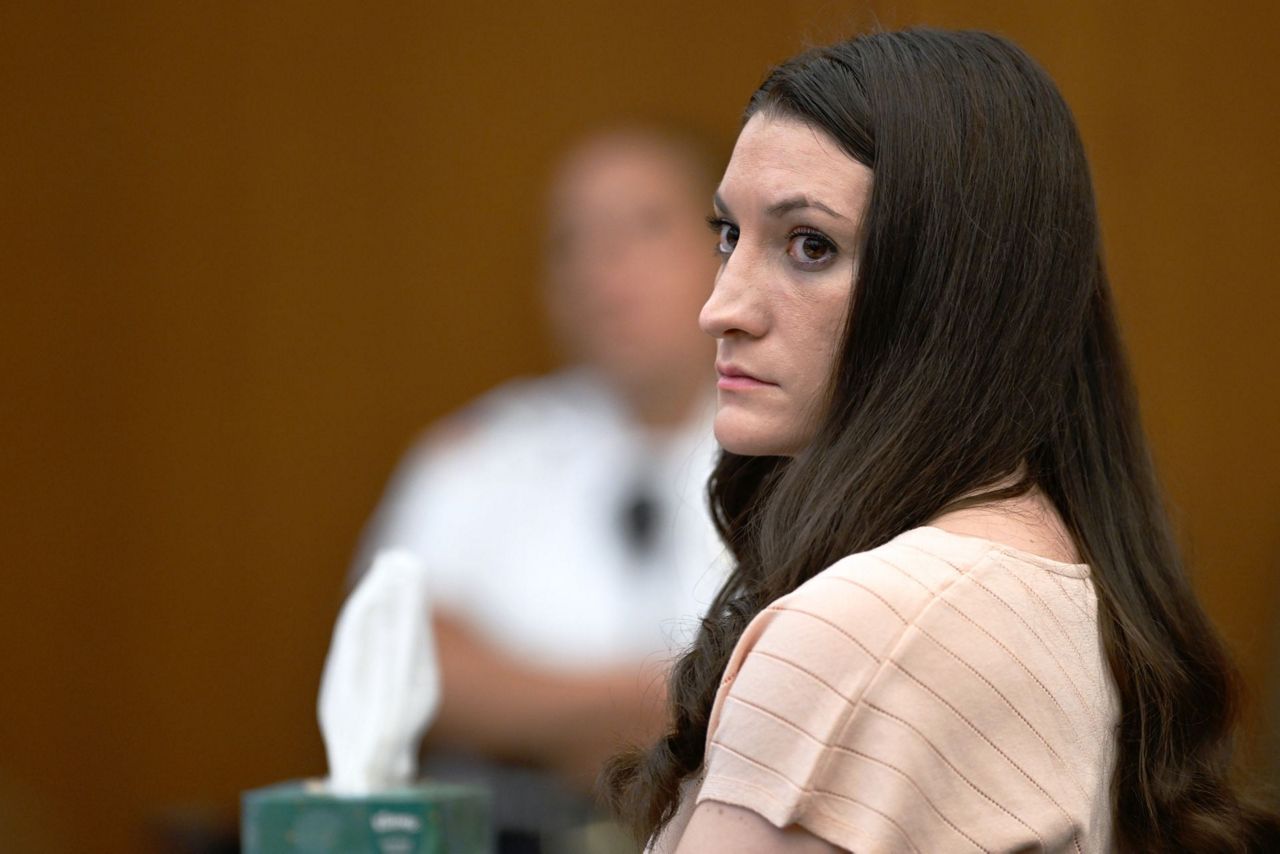
Lindsay Clancy killed her three children.
That central fact is not disputed by prosecutors, by her attorneys or by Clancy herself.
On January 24, 2023, Clancy strangled 5-year-old Cora, 3-year-old Dawson and 8-month-old Callan with exercise bands in the basement of the family's Duxbury, Massachusetts, home. She then cut herself and jumped from a second-story window in an attempt to take her own life, surviving with injuries that left her paralyzed.
As of late Thursday morning, a Plymouth County jury was in its sixth day of deliberations after twice telling Judge William Sullivan that it could not reach a unanimous verdict. A mistrial remains possible.
The legal question is whether Clancy was criminally responsible when she killed Cora, Dawson and Callan.
Her defense argues that postpartum psychosis destroyed her ability to appreciate the wrongfulness of her actions or conform her conduct to the law. Prosecutors say she was severely depressed and psychologically troubled but still understood exactly what she was doing.
Patriot Briefing Room does not find the defense persuasive.
Mental illness is real. Postpartum psychosis is real. Neither fact establishes that Lindsay Clancy was psychotic when she killed three children.
In our view, the evidence publicly presented at trial supports holding her fully criminally responsible. If jurors conclude that the Commonwealth proved first-degree murder beyond a reasonable doubt, Massachusetts law requires life in prison without parole. We believe that would be a just outcome.
Her treating doctors diagnosed depression—not psychosis
The strongest reason for skepticism toward the defense is not political rhetoric. It is the contemporaneous medical record.
Clancy unquestionably had significant psychiatric problems before the killings. She struggled with anxiety, depression, insomnia, medication changes and suicidal thoughts. She repeatedly sought treatment and voluntarily entered McLean Hospital in January 2023.
But Dr. Alia Goodheart, a McLean psychiatrist involved in Clancy's treatment, testified that Clancy was diagnosed with major depressive disorder, severe, without psychotic features. Goodheart said she did not observe psychosis and considered Clancy a relatively low safety risk when she left McLean on January 5, 19 days before the killings.
Even more significant was the testimony of Dr. Jennifer Tufts, Clancy's treating psychiatrist immediately before the deaths.
Tufts saw Clancy on January 23—the day before Cora, Dawson and Callan were killed. She testified that Clancy denied suicidal and homicidal ideation and showed no signs of psychosis or mania.
That evidence does not make a rapidly developing psychotic episode medically impossible. But criminal trials should turn on evidence, not merely on what could theoretically have happened.
The professionals evaluating and treating Clancy before the killings documented serious mental illness. They did not diagnose postpartum psychosis.
The command-hallucination claim came later
The defense's central explanation is that Clancy heard a male voice commanding her to kill the children and then herself.
Defense forensic psychiatrist Dr. Phillip Resnick evaluated Clancy after the killings and concluded that she had been psychotic. He testified that she experienced a command hallucination and therefore lacked criminal responsibility.
Jurors are entitled to take that opinion seriously.
They are also entitled to ask why the most consequential claimed symptom was absent from the records generated while doctors were actually treating her before January 24.
Clancy had been evaluated by multiple providers. She had been hospitalized. She had discussed her fears, her medications, suicide and psychiatric symptoms. Yet her clinicians did not document a command hallucination telling her to kill her children.
The alleged voice emerged in the account given after the killings.
That does not by itself prove fabrication. Psychiatric patients can conceal hallucinations, and symptoms can be transient.
But the prosecution presented experts who disputed the defense's retrospective conclusion. Forensic psychologist Dr. Kirk Heilbrun testified that an alleged hallucination appearing around the time of the killings and not persisting would be highly unusual and warranted careful scrutiny. Other prosecution experts concluded that Clancy was mentally ill but retained criminal responsibility.
This is not a contest between people who believe in mental illness and people who do not.
It is a dispute over whether the evidence establishes legal insanity at the precise time three children were intentionally killed.
Her behavior before the killings matters
Prosecutors have also pointed to Clancy's conduct on January 24.
They argue that she arranged for Patrick Clancy to leave the house to pick up medication and takeout, checked travel timing and used that period alone with the children to carry out the killings.
The defense disputes the prosecution's interpretation and says the killings followed a sudden psychotic command.
But purposeful conduct is relevant. Planning, timing and creating privacy can be evidence that a defendant was acting deliberately rather than in a state that eliminated the capacities Massachusetts law requires.
Clancy's own phone history also complicates a simplistic narrative. Trial testimony showed that before the killings she searched online for information about hallucinations, psychosis, suicide methods, bipolar disorder, insomnia and medication side effects. That evidence can be interpreted in more than one way. It documents genuine distress, but it also shows that she had concepts of psychosis and hallucinations in mind before the later defense centered on those ideas.
Jurors must decide what weight those facts deserve.
Mental illness is not the same as legal insanity
This distinction extends far beyond Clancy.
Massachusetts law does not ask merely whether a defendant was depressed, traumatized, psychotic at some point, sleep deprived or otherwise mentally ill.
Under the state's criminal-responsibility standard, a defendant is not criminally responsible when a mental disease or defect caused a lack of substantial capacity either to appreciate the criminality or wrongfulness of the conduct or to conform that conduct to the requirements of law.
Once the issue is properly raised, the Commonwealth bears the burden of proving criminal responsibility beyond a reasonable doubt.
That rule is sex-neutral.
There is no special Massachusetts legal carve-out for mothers who kill their children after childbirth. A father suffering from a qualifying mental disease is entitled to invoke the same standard. So is any other defendant.
That is exactly how it should be.
A person can be profoundly psychologically disturbed and still criminally responsible. The fact that someone committed a grotesque crime cannot itself become proof that the person was too mentally ill to answer for it.
Otherwise the insanity defense would become easiest to establish in the most horrifying cases.
Mothers and fathers deserve one standard
The public reaction surrounding Clancy raises another legitimate question.
Large numbers of women have identified with her postpartum struggles, followed the trial intensely and traveled to the courthouse. Some see Clancy primarily as a woman failed by American mental-health care.
Better postpartum psychiatric treatment is a worthy cause.
But sympathy is not evidence.
Would the reaction be the same if a father admitted strangling his 5-year-old, 3-year-old and 8-month-old children and later argued that severe depression, overwhelming parental stress, sleep deprivation and psychiatric illness should reduce or erase his responsibility?
We should not assume the answer. But we should be willing to ask the question.
Fathers can suffer severe mental illness after children are born. They can experience crushing stress, sleep loss and major psychological changes. None of that ordinarily causes society to presume that a father who kills his children should be excused.
Nor should it.
The same principle should govern mothers.
Pregnancy and childbirth create unique biological risks, and postpartum psychosis can be a genuine psychiatric emergency. Recognizing those facts does not require lowering the evidentiary standard for criminal responsibility.
The conspiracy campaign against Patrick Clancy is not evidence
Parts of the online discussion have gone considerably further than sympathy for Lindsay.
Some TikTok, Instagram and true-crime users have tried to shift blame onto Patrick Clancy.
There is no evidentiary foundation for that accusation.
Lindsay Clancy's own defense does not claim Patrick killed the children. Her lawyers acknowledge that Lindsay killed them and argue instead that she lacked criminal responsibility.
Patrick has not been charged. Prosecutors have not identified him as a participant. His trip to CVS and the restaurant was investigated and supported by testimony and digital or surveillance evidence introduced at trial.
Yet internet sleuths have treated his clothing, body language, remarriage, movements and supposed "vibes" as clues in an invented murder mystery.
Some social-media commentary has gone even further into absurdity, invoking astrology and zodiac signs as supposed reasons to distrust Patrick or believe Lindsay would not have killed her children.
That is not skepticism.
It is conspiracy thinking attached to a real family's catastrophe.
Boston-area reporting has documented the phenomenon in detail: Lindsay admits killing the children, yet online creators continue building theories that Patrick somehow did it or framed her.
"Intuition" is not forensic evidence. "Vibes" are not evidence. A zodiac sign is not evidence.
A grieving father does not have to perform grief in a way that satisfies TikTok creators in order to be presumed innocent of a crime nobody investigating the case has accused him of committing.
True-crime fandom can turn suffering into entertainment
The Patrick theories expose a larger problem with online true-crime culture.
A short video isolates one supposedly suspicious detail. Another creator repeats it. An algorithm places the clips beside one another. Repetition begins to feel like corroboration.
Soon thousands of viewers believe they have discovered something detectives, prosecutors, defense lawyers and jurors somehow missed.
The Clancy case is especially revealing because the basic perpetrator question is not actually unresolved.
The trial is about criminal responsibility.
But that answer apparently is not satisfying enough for a social-media ecosystem that rewards mystery, villain-swapping and confident speculation.
Real people pay the price when entertainment masquerades as investigation.
Compassion belongs first to Cora, Dawson and Callan
Clancy suffered.
She had serious mental-health problems. She sought treatment. Her medical care deserves scrutiny. Her suicide attempt left her with catastrophic injuries.
Those facts can all be true.
But Cora is dead.
Dawson is dead.
Callan is dead.
They were five years old, three years old and eight months old.
They had no ability to leave the house, call police or protect themselves.
The moral center of this case should not drift so far toward the defendant that the children become supporting characters in the story of her suffering.
Mental-health advocacy should focus relentlessly on prevention before a family reaches this point. Women experiencing dangerous postpartum symptoms need rapid, serious treatment. Families need to know when psychiatric warning signs demand emergency intervention.
But after three children are intentionally killed, society also has an obligation to pursue justice.
"The system failed her" does not settle responsibility
Perhaps Clancy should have received different medical treatment.
Perhaps a provider missed something important.
Perhaps different medication decisions would have changed the course of events.
Those are legitimate subjects for malpractice litigation and medical review.
They do not automatically answer whether Clancy herself was criminally responsible.
A system can fail a person while that person remains accountable for what she does.
Conservatism is built in part on that understanding of agency. Rights and responsibility travel together. A free society treats adults as moral actors capable of making choices, except when the evidence establishes that a qualifying disease truly destroyed that capacity.
The exception is necessary.
It should also remain an exception.
PBR's conclusion
Only the jury can return a verdict in Commonwealth v. Clancy.
PBR does not pretend otherwise.
But an independent publication can evaluate the public evidence and state an editorial conclusion.
Ours is clear.
Lindsay Clancy was seriously mentally ill.
The evidence presented publicly does not persuade us that her illness eliminated her criminal responsibility when she killed Cora, Dawson and Callan.
Her treating doctors documented severe depression but did not diagnose postpartum psychosis before the killings. Her psychiatrist saw her the day before and observed no psychosis or mania. The command-hallucination account became central afterward and is disputed by prosecution experts. Prosecutors also presented evidence of purposeful conduct surrounding Patrick's departure from the house.
And the social-media campaign trying to manufacture a different killer out of Patrick Clancy offers speculation, body-language theories, "intuition," "vibes" and even astrology—not evidence.
If this jury finds that prosecutors proved first-degree murder beyond a reasonable doubt, Massachusetts law mandates life without parole.
We believe the evidence supports holding Clancy fully responsible and that such a sentence would be appropriate.
Mental illness should be treated seriously.
Postpartum psychiatric emergencies should be recognized early.
Health-care failures should be investigated where the facts support them.
None of that requires abandoning accountability for three dead children.
Cora, Dawson and Callan deserve better than to have their deaths explained away.
Sources
- Associated Press: Deadlocked jury enters sixth day of deliberations
- Reuters: Jury resumes deliberations; sentencing possibilities
- CBS Boston: Testimony from Clancy's treating psychiatrists
- CBS News: Key evidence and Dr. Jennifer Tufts' testimony
- Associated Press via Spectrum News: Clancy's phone searches and provider testimony
- Massachusetts courts: Criminal-responsibility standard
- Boston.com: Unsupported conspiracy theories targeting Patrick Clancy
- Boston Globe: Baseless online claims surrounding the case
- The Journal: Social-media theories blaming Patrick despite the trial record
- The Atlantic: The unusually intense supporter culture surrounding the trial