
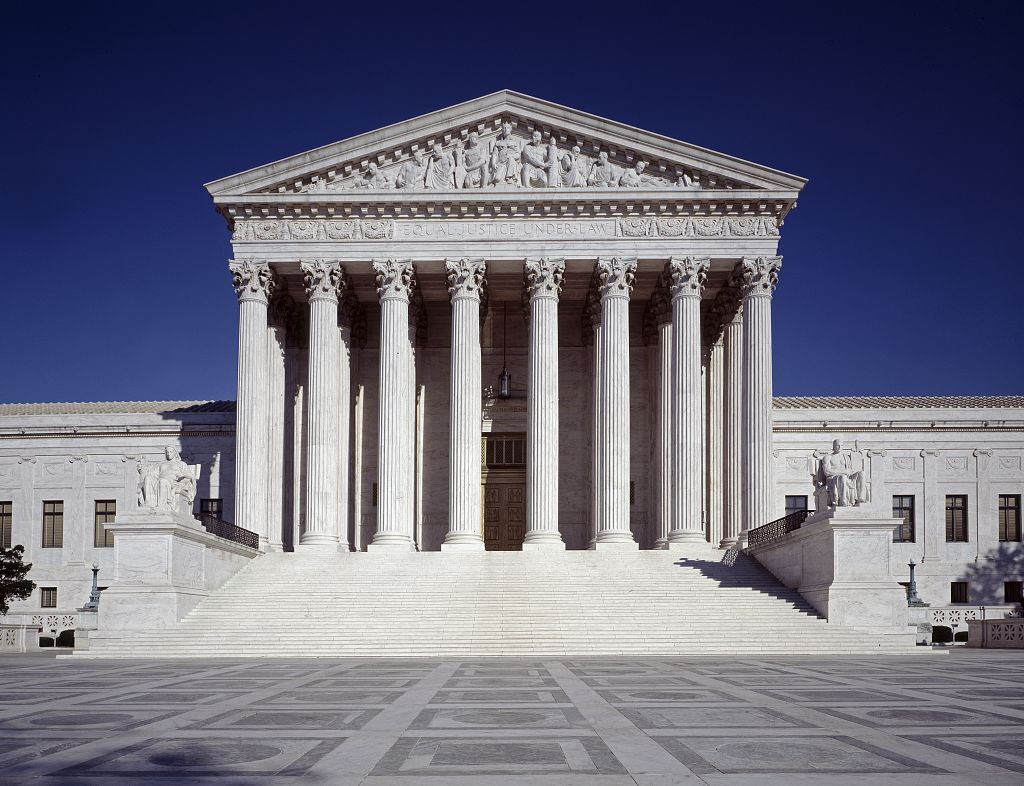
WASHINGTON — House Democrats overwhelmingly rejected a proposed constitutional amendment Wednesday that would have permanently fixed the U.S. Supreme Court at nine justices.
H.J. Res. 1 received 212 votes in favor and 206 against, with 15 members not voting. Because constitutional amendments require approval from two-thirds of each chamber, the measure fell far short of the threshold needed to advance.
Only one Democrat, North Carolina Rep. Don Davis, reportedly joined Republicans in support.
The resolution proposed a simple but consequential constitutional rule: The Supreme Court would consist of one chief justice and eight associate justices.
The Constitution created the Supreme Court but did not specify its size. Congress has changed the number of seats several times, and the Court has operated with nine justices since 1869. Today, that number is set by federal law and could be changed through ordinary legislation.
Had the amendment cleared both chambers, it still would have required ratification by 38 states within seven years.
A political vote with a real institutional question
Republicans plainly intended the vote to serve an election-year purpose.
With the November 3 midterms approaching, GOP leaders wanted Democrats placed on the record over proposals to expand the Court beyond its current 6–3 conservative majority. Several Democratic lawmakers have supported legislation that would increase the Court to 13 seats.
Democrats opposing the amendment argued that Republicans were attempting to preserve the Court’s present ideological makeup and strip future Congresses of a constitutional check on the judiciary.
That political motivation does not make the underlying question meaningless.
If either party can add seats whenever it gains control and dislikes the Court’s rulings, the country risks entering a cycle in which every change in power produces another attempt to restructure the judiciary.
A Democratic Congress might expand the Court to offset a conservative majority. A later Republican Congress could respond by adding more seats of its own. Nothing in the logic of partisan expansion creates a natural stopping point.
What the vote does—and does not—prove
A vote against H.J. Res. 1 should not automatically be characterized as a vote to pack the Court.
Some lawmakers may oppose court expansion while also believing that the Constitution should continue giving Congress authority to determine the number of justices. Others may have objected to locking the current structure into the Constitution during a heated election season.
The vote does, however, leave the expansion option available.
That makes it reasonable for voters to ask every candidate a direct question: Should Congress ever increase the number of Supreme Court seats because one party objects to the Court’s ideological balance or recent decisions?
Members who voted against a permanent cap should explain what limits, if any, they would support.
PBR analysis
Republicans staged a messaging vote, but Democrats cannot dismiss the institutional concern simply because the opposing party raised it.
Court expansion based on temporary political advantage would damage public confidence in an institution that already suffers from deep partisan distrust. Once one party changes the number of justices to obtain favorable rulings, the other party gains both the incentive and the justification to retaliate.
At the same time, constitutional amendments should not be adopted merely to protect the advantage of the party currently satisfied with the Court.
The most defensible standard is one established before either party knows who will benefit from it. Congress should openly debate a lasting rule for the Court’s size—and lawmakers on both sides should state whether they would accept that same rule when the ideological balance runs against them.
Wednesday’s vote settled nothing. It did, however, put nearly every House member on record and ensure that the future size of the Supreme Court remains part of the midterm debate.
Sources
- U.S. House Clerk: Roll Call 293 on H.J. Res. 1
- U.S. Government Publishing Office: reported text of H.J. Res. 1
- Congressional Budget Office: H.J. Res. 1 cost estimate and ratification requirements
- Reuters: House vote on the proposed nine-justice amendment
- New York Post: party breakdown and Democratic crossover vote
- League of Conservation Voters: argument opposing the constitutional amendment
- Library of Congress: Supreme Court file photo by Carol M. Highsmith